2026-06-17 東北大学
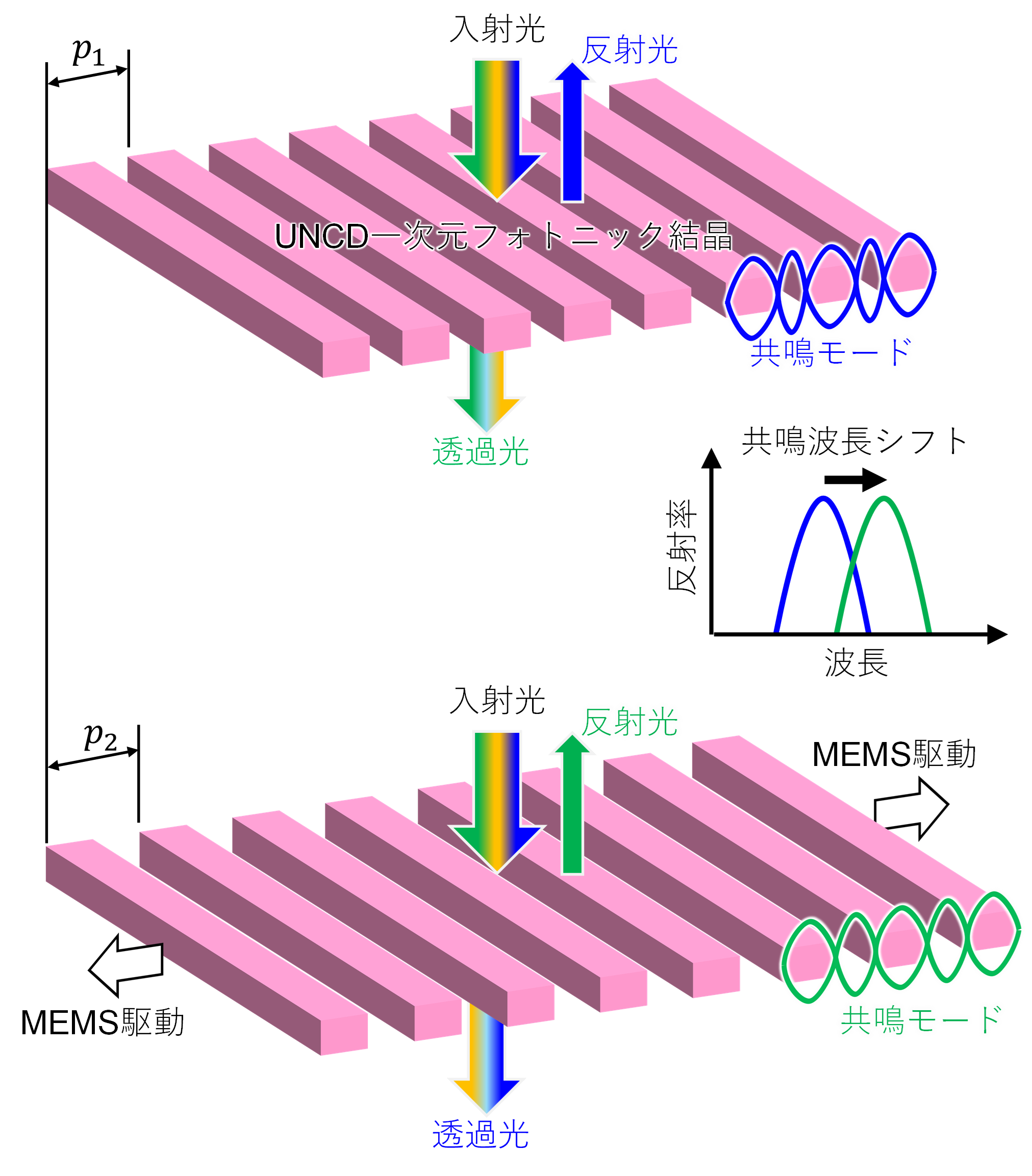
図1. 機械可変ダイヤモンドフォトニック結晶の波長制御原理。MEMS駆動によりフォトニック結晶の周期が初期周期 p1から周期 p2に変化し、それに伴って共鳴波長がシフトする。
<関連情報>
- https://www.tohoku.ac.jp/japanese/2026/06/press20260617-02-mems.html
- https://www.sciencedirect.com/science/article/pii/S0925963526005212
機械的に調整可能な超ナノ結晶ダイヤモンド1次元フォトニック結晶スラブ Mechanically tunable ultrananocrystalline diamond 1D photonic crystal slab
Taro Ikeda, Yoshiaki Kanamori
Diamond and Related Materials Available online: 2 June 2026
DOI:https://doi.org/10.1016/j.diamond.2026.113810
Highlights
- Mechanical tuning of optical modes in diamond photonic devices is demonstrated.
- Pitch of an UNCD 1D photonic crystal slab is modulated by comb-drive actuators.
- Guided modes and the corresponding reflection peaks are shifted by the actuation.
- The underlying concept and mechanism are independent of the diamond’s crystalline form.
Abstract
Diamond is considered a promising platform for power-semiconductor, photonic, mechanical, and quantum devices owing to its exceptional material properties, including the existence of optically active color centers. In particular, diamond photonic crystals have attracted significant attention and have been tailored primally aimed at enhancing the luminescence from these color centers. Photonic crystals provide strong optical confinement through their high-quality resonances; however, because they are highly sensitive to fabrication deviations that shift the resonant wavelength, a practical and broadly applicable strategy for tuning the optical modes is required. In this study, we demonstrate a mechanically tunable ultrananocrystalline diamond (UNCD) one-dimensional (1D) photonic crystal (PhC) slab and the mechanical tuning of its optical response. The UNCD 1D PhC slab is integrated with electrostatic submicron-comb drive UNCD actuators, which modulate the optical response by mechanically tuning the period from 1004nm to 1076nm with an acceptable driving voltage of 75V. This period modulation alters the guided modes of the UNCD 1D PhC slab, consequently shifting the resonant wavelength and the corresponding reflection peak from 1031nm to 1054nm in TE polarization. The underlying concept and tuning mechanism are independent of the crystalline form of diamond. These results establish a new tuning strategy for diamond photonic devices and open up new possibilities for their applications.