2026-06-12 合肥物質科学研究院(HFIPS)
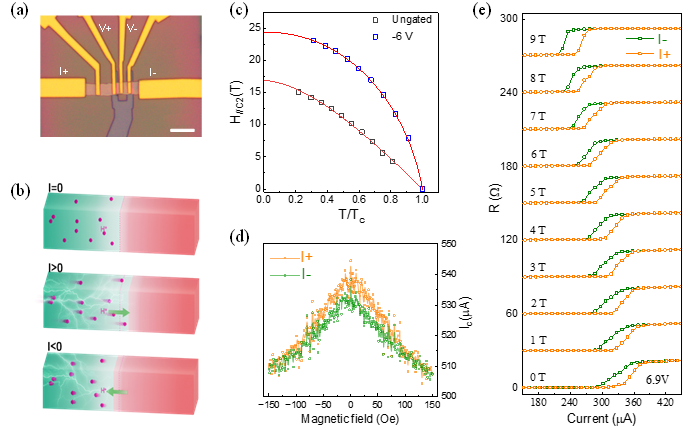
A general framework for time-reversal symmetric superconducting diode effect (Image by ZHENG Guolin)
<関連情報>
- https://english.hf.cas.cn/nr/rn/202606/t20260612_1161954.html
- https://journals.aps.org/prx/abstract/10.1103/wm2k-vlvc
ゲート定義型ホモ接合における極性調整可能な時間反転対称超伝導ダイオード効果を実現する一般的なフレームワーク General Framework Enabling Polarity-Tunable Time-Reversal Symmetric Superconducting Diode Effects in Gate-Defined Homojunctions
Hongwei Zhang, Chunsheng Wang, Ran Wang, Senyang Pan, Hengning Wang, Jiaqiang Cai, Yonglai Liu, Zhe Qu, Xiangde Zhu et al.
Physical Review X Published: 29 May, 2026
DOI: https://doi.org/10.1103/wm2k-vlvc
Abstract
Symmetry breaking underlies various nonreciprocal transport phenomena. A well-known example is the semiconductor p−n junction diode, a cornerstone of modern electronics. Its superconducting counterpart—the superconducting diode effect (SDE)—has recently attracted intense interest due to its potential in ultra-low-power superconducting circuits. While most SDEs reported so far involve either explicit or spontaneous breaking of time-reversal symmetry (TRS), a comprehensive theoretical framework remains elusive. Moreover, a general mechanism enabling TRS-preserving SDEs with minimal dependence on material or device architecture has yet to be established. Here, we report polarity-tunable SDEs without breaking TRS, realized in superconducting n−n, p−n, and p−p homojunctions defined via local protonic gates in multilayer NbSe2. The local gates induce partial proton intercalation, generating a built-in proton concentration gradient across the transition zone between the gated and ungated regions—closely resembling the depletion layer in conventional semiconductor diodes. We find that the observed SDE arises from electric-field-driven variation of the proton concentration gradient in the transition region, which asymmetrically modulates the critical current: suppressing it in one direction and enhancing it in the other. This local-gate-driven, TRS-preserving mechanism offers a general and scalable strategy for realizing nonreciprocal superconducting transport. Our findings establish a material-agnostic platform for SDEs, broadly applicable across two-dimensional (2D) superconductors.