2026-06-11 中国科学院(CAS)
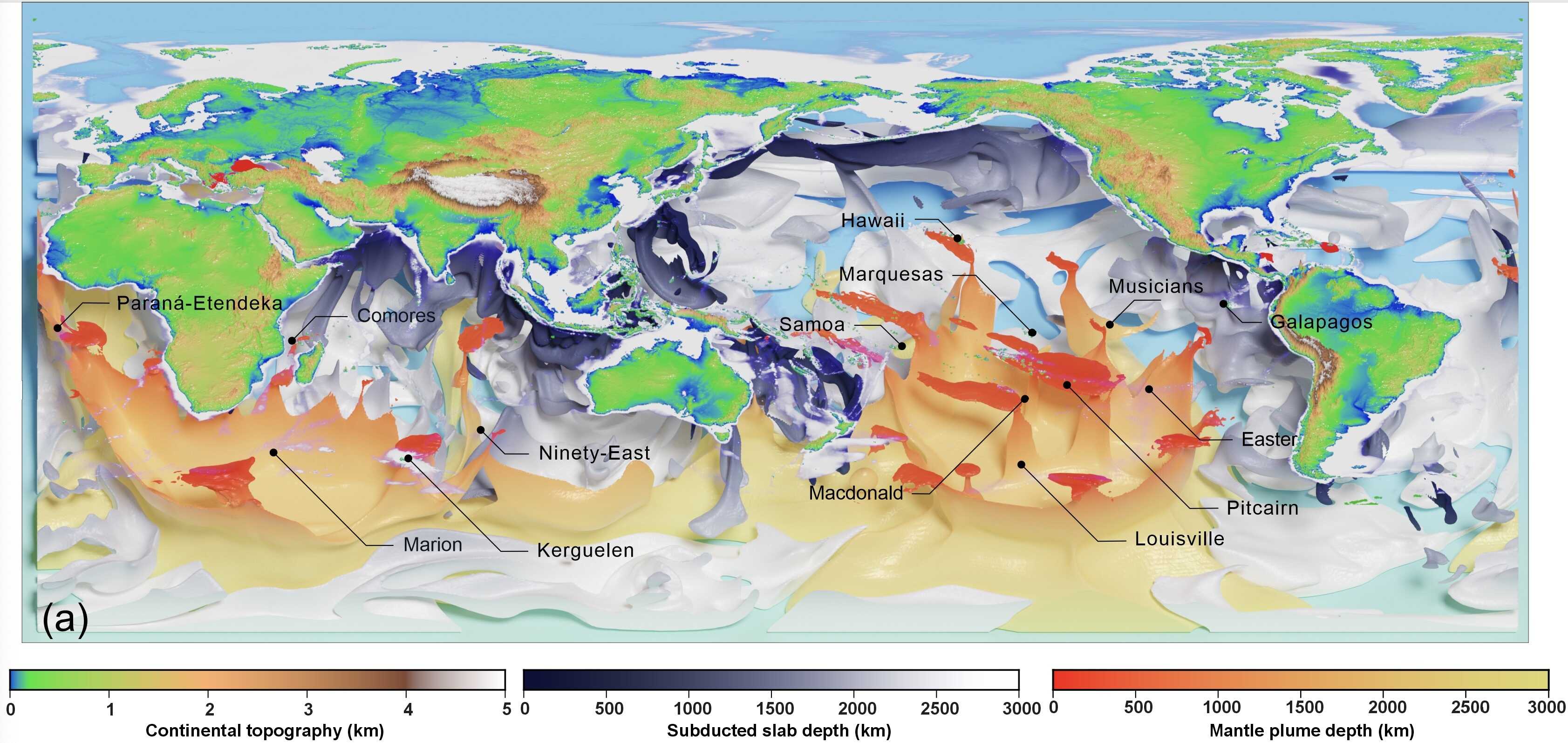
Comparison between the modeled present-day 3D mantle plume structure and geological observations. The upper surface shows continental topography, while white regions show continental shelves, seamounts, island arcs, and other geological features. Orange isosurfaces represent mantle plumes, while gray isosurfaces indicate subducting slabs deeper than 300 km. (Image by IGG)
<関連情報>
- https://english.cas.cn/newsroom/research-news/202606/t20260610_1161551.shtml
- https://www.nature.com/articles/s41561-026-02006-0
海洋プレート内火山活動の深部マントルプルーム起源 Deep mantle plume origin of oceanic intraplate volcanism
Hao Dong (董昊),Lijun Liu (刘丽军),Zebin Cao (曹泽斌),Yanchong Li (李衍冲),Sanzhong Li (李三忠),Jinping Liu (刘金平),Liming Dai (戴黎明) & Rixiang Zhu (朱日祥)
Nature Geoscience Published:10 June 2026
DOI:https://doi.org/10.1038/s41561-026-02006-0
Abstract
Volcanism far from tectonic plate margins provides important insights into the dynamic evolution of Earth’s interior. On oceanic plates, an age-progressive volcanic seamount chain is generally attributed to the plate moving over a mantle plume. However, many seamounts are spatially scattered without clear age progression, so their relationship to deep mantle processes has been contentious. Here we show from numerical modelling that all seamounts—with or without age progression—are produced by deep plume-related activity. Specifically, we present a high-resolution mantle convection model with data assimilation simulating the thermal evolution of the mantle from 270 Ma, which we use to reconstruct age trends of major hotspot tracks since the Cretaceous. We find that most Cretaceous seamounts in the Pacific Ocean formed above major plume heads ponding beneath the young oceanic plate, where the resulting hot zones fuelled widespread intraplate volcanism without age progression. Subsequently, the ageing and expanding Pacific Plate covered more plume conduits from its shrinking neighbouring plates, forming the observed Cenozoic age-progressive hotspot tracks above the narrow plume tails. In addition, the resulting widespread and long-lived residual thermal anomalies, which we term seamount brewing zones, eventually formed small-volume scattered seamounts. This mechanism offers a unified framework for the formation of intraplate seamounts, substantially expanding the classical mantle plume hypothesis.