2026-06-11 中国科学院(CAS)
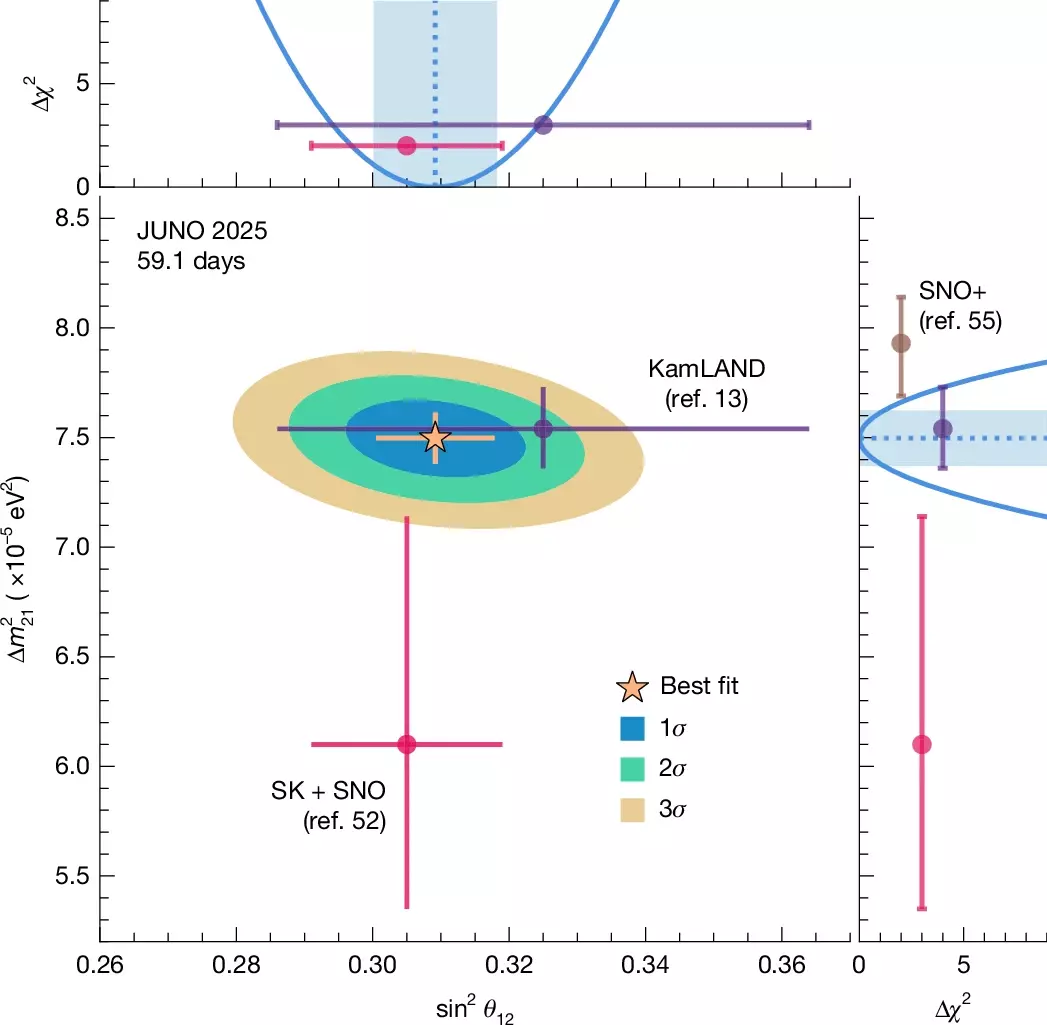
Figure 3: The first physics result of JUNO (Image by JUNO Collaboration)
<関連情報>
- https://english.cas.cn/newsroom/headlines/202606/t20260611_1161560.shtml
- https://www.nature.com/articles/s41586-026-10538-z
- https://tiisys.com/blog/2025/11/21/post-180249/
JUNOの最初のデータを用いた原子炉ニュートリノ振動の測定 Measurement of reactor neutrino oscillation with the first JUNO data
The JUNO Collaboration
Nature Published:10 June 2026
DOI:https://doi.org/10.1038/s41586-026-10538-z
Abstract
Neutrino oscillations (see refs. 1,2 and references therein), a quantum effect manifesting at macroscopic scales, are governed by lepton flavour mixing angles and neutrino mass-squared differences3 that are fundamental parameters of particle physics, representing phenomena beyond the Standard Model. Precision measurements of these parameters are essential for testing the completeness of the three-flavour framework, determining the mass ordering of neutrinos and probing possible new physics. The Jiangmen Underground Neutrino Observatory (JUNO)4 is a 20-ktonne liquid-scintillator detector located 52.5 km from multiple reactor cores, designed to resolve the interference pattern of reactor neutrinos with sub-percent precision5,6. Here we report, using the first 59.1 days of data collected since detector completion in August 2025, the first simultaneous high-precision determination of two neutrino oscillation parameters,sin2θ12=0.3092±0.0087 and △m221=(7.5±0.12)×10-5eV20for the normal mass ordering scenario, improving the precision by a factor of 1.6 relative to the combination of all previous measurements. These results advance the basic understanding of neutrinos, validate the design of the detector and indicate the readiness of JUNO for resolving the neutrino mass ordering with a larger dataset. The rapid achievement with a short exposure highlights the potential of JUNO to push the frontiers of precision neutrino physics and paves the way for its broad scientific programme.