

2026-06-04 スイス連邦工科大学ローザンヌ校(EPFL)
超高速レーザーは、眼科手術、精密微細加工、光周波数コム、光格子時計などに利用される重要技術だが、高出力化と小型化の両立は長年の課題だった。研究チームは「Mamyshev発振器」と呼ばれる比較的見過ごされてきたレーザー構造を採用し、エルビウム添加シリコン窒化物フォトニックチップ上で高性能なモード同期レーザーを実現した。その結果、147フェムト秒という極短パルス幅と1.05ナノジュールのパルスエネルギーを達成し、卓上型フェムト秒レーザーに匹敵する性能を示した。さらに、1枚のチップ上に1000個以上のレーザー共振器を集積可能であり、量産化にも適している。
これにより、高価で大型の研究用レーザーを置き換える可能性が生まれ、医療診断、高度センシング、光通信、次世代光原子時計など幅広い分野への応用が期待される。20年以上にわたり「集積フォトニクスの聖杯」と呼ばれてきた課題の実現として注目されている。
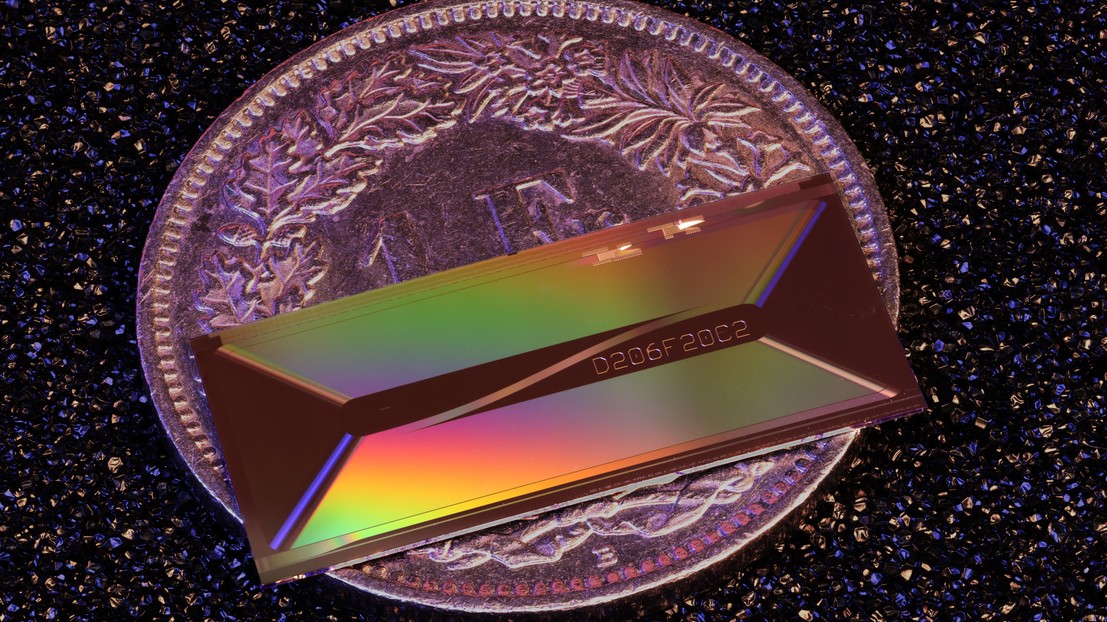
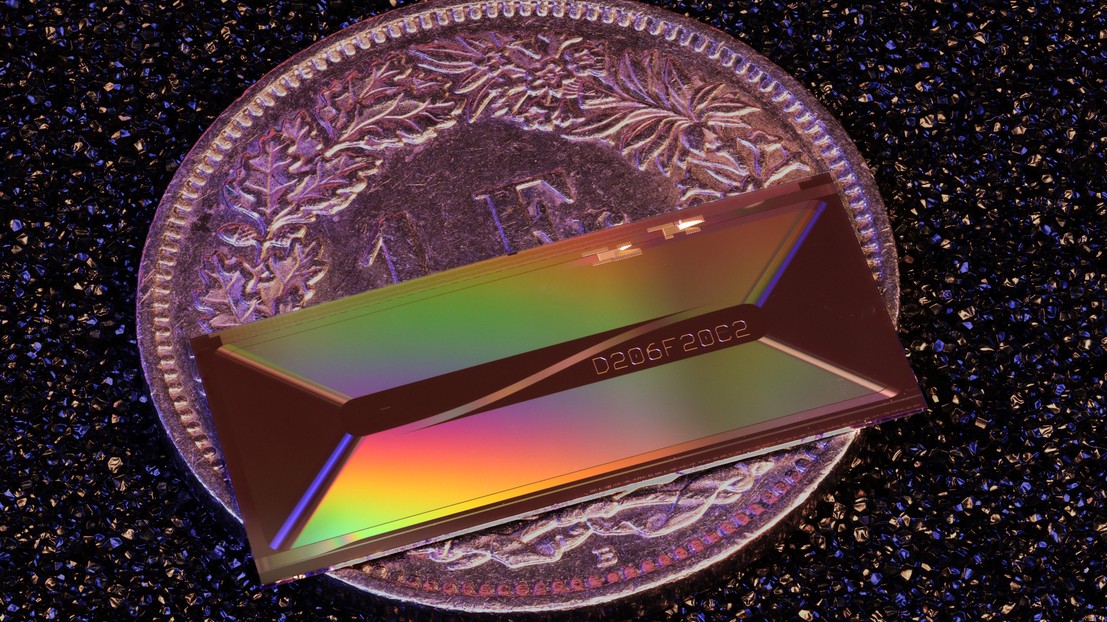
Placed on a 1 CHF coin for scale, EPFL’s photonic chip shows how a laser architecture once confined to table-top systems can be shrunk to the millimeter scale. ©2026 EPFL/Zheru Qiu
<関連情報>
- https://actu.epfl.ch/news/a-ultrafast-laser-on-a-chip/
- https://www.nature.com/articles/s41586-026-10517-4
マミシェフ発振器を用いた高パルスエネルギー集積型モード同期レーザー High-pulse-energy integrated mode-locked laser using a Mamyshev oscillator
Zheru Qiu,Xuan Yang,Xurong Li,Jianqi Hu,Zhongshu Liu,Yichi Zhang,Xinru Ji,Jiale Sun,Grigory Lihachev,Zihan Li,Ulrich Kentsch & Tobias J. Kippenberg
Nature Published:03 June 2026
DOI:https://doi.org/10.1038/s41586-026-10517-4
Abstract
Ultrafast lasers have led to numerous advances across science and technology: they enabled corneal surgery1, revealed chemical reaction dynamics2 and triggered the development of optical atomic clocks3. Over the past decades, extensive efforts have aimed to realize mode-locked lasers based on photonic integrated circuits (PICs) that are compact, manufactured at wafer scale and are compatible with further on-chip functionalities4,5,6. Yet, existing demonstrations to date lack the pulse energy required to drive nonlinear processes, such as supercontinuum generation. Here we demonstrate a mode-locked laser that overcomes this challenge through the use of erbium-ion-implanted silicon nitride PICs7. The laser is based on the Mamyshev oscillator architecture8, in which alternating spectral filtering and self-phase modulation enable mode-locking and can support large nonlinear phase shifts9. It operates without external seeding, delivering a 176-MHz pulse train with nanojoule pulse energy, comparable with fibre lasers and exceeding previous PIC-based sources by two orders of magnitude. The output exhibits high coherence, can be linearly compressed to 147 fs and can directly drive a 1.5-octave-spanning supercontinuum in a Si3N4 waveguide, without any further amplification. A compact terahertz time-domain spectrometer driven by this source achieved a bandwidth of 5 THz and a 90-dB dynamic range. We demonstrate its application in non-contact chemical analysis and inspection. Our results show the potential of an integrated ultrafast laser, with applications ranging from chip-scale frequency metrology to portable spectroscopy systems.
/https%3A%2F%2Ffilelist.tudelft.nl%2FLR%2FActueel%2FNews%2F2026%2FQ2%2Fcollage1.png%3Fhash%3Df4bef09816 "ムササビの飛行制御を模倣したドローンを開発(Flying Squirrel Drone Reshapes Drone Design)")
