2026-05-27 愛媛大学
δ-AlOOHの変形微細組織、結晶選択配向と地震波異方性
<関連情報>
- https://www.ehime-u.ac.jp/data_relese/pr_20260527_grc/
- https://agupubs.onlinelibrary.wiley.com/doi/10.1029/2026GL122235
高圧含水鉱物δ-AlOOHとH相固溶体の変形とその中部マントルにおけるスラブ内地震波異方性の成因としての可能性 Deformation of δ-AlOOH and Its Solid Solution With Phase H as a Potential Source of Intra-Slab Seismic Anisotropy in the Mid-Mantle
Wentian Wu, Yu Nishihara, Noriyoshi Tsujino, Sho Kakizawa, Yuji Higo
Geophysical Research Letters Published: 12 May 2026
DOI:https://doi.org/10.1029/2026GL122235
Abstract
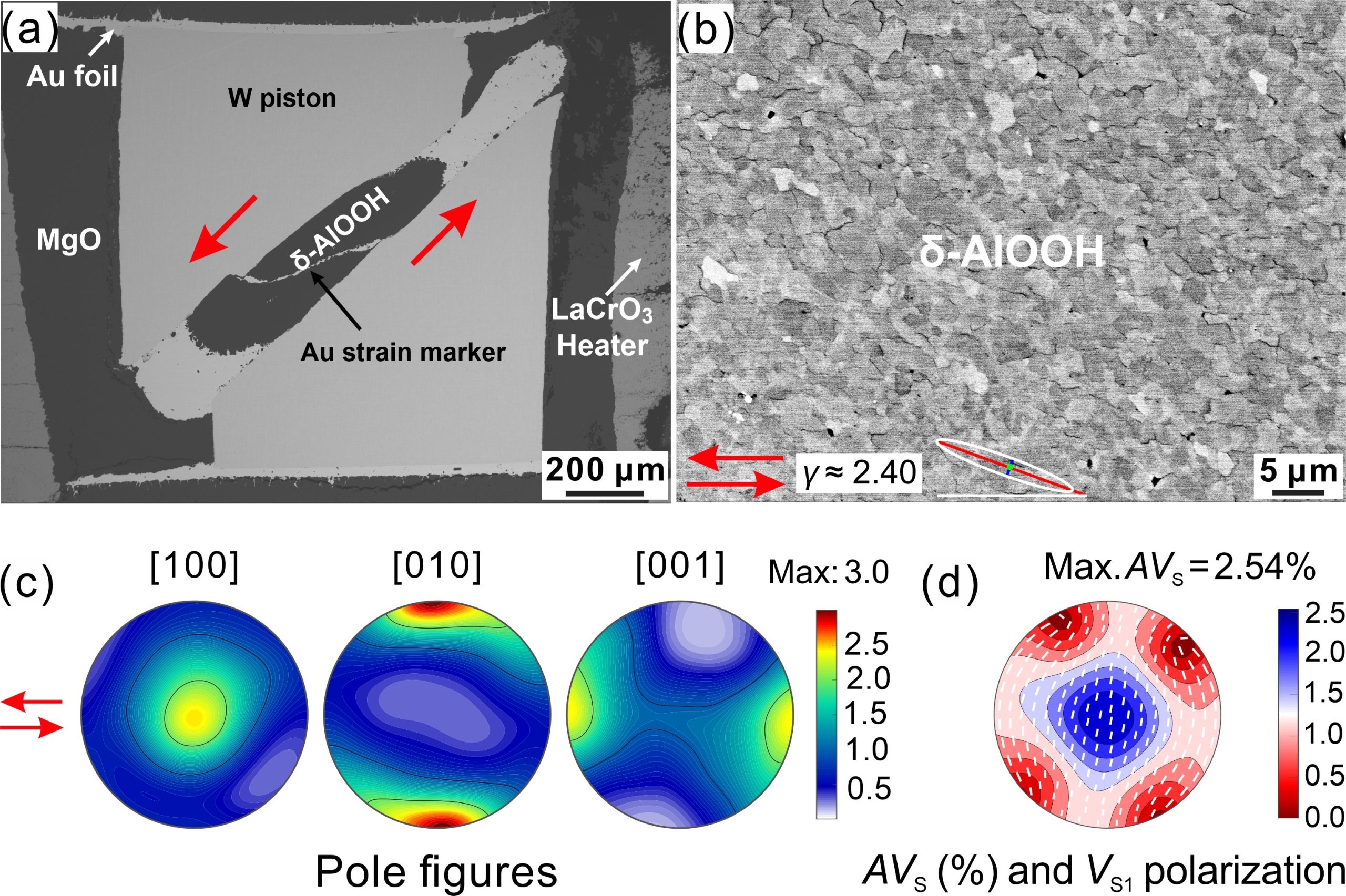
Seismic anisotropy is widely observed near subduction zones in the mantle transition zone and uppermost lower mantle, particularly along the western Pacific rim and tracks slabs geometries, implying an additional slab-related source. Hydrous phases such as δ-AlOOH and phase H (MgSiO4H2), which form a solid solution (δ-H) and are stable in cool, hydrated slabs, are potential contributors. We performed well-controlled deformation experiments on δ-AlOOH and δ-H at 20.5–24.5 GPa and 800°C–1000°C. Deformed aggregates developed strong crystallographic preferred orientation (CPO), and simple-shear experiments on δ-AlOOH identified (010)[001] as the likely dominant slip system, with subsidiary systems inferred from intragranular misorientation. The resulting CPOs produce vertically polarized shear-wave velocities exceeding horizontally polarized velocities (VSV > VSH) with strong azimuthal anisotropy under sub-horizontal shearing. We suggest that these phases generate negative radial anisotropy under horizontal flow and can partly contribute to the anisotropy near flattened slab tops.
Plain Language Summary
When seismic waves travel through rocks deep inside the Earth, they can move faster in some directions than in others. This directional behavior, called seismic anisotropy, is widely observed beneath subduction zones, especially where cold tectonic plates sink and flatten in the mantle. However, the origin of this anisotropy is not fully understood. Our study focuses on special water-bearing minerals that can exist in cool, hydrated slabs at great depths. We carried out high-pressure and high-temperature experiments on two such minerals, δ-AlOOH and its solid solution with phase H (δ-H), which are stable under relatively cool slab geotherms, to better understand how these hydrous minerals deform inside subducting slabs in the mantle transition zone. We found that when these mineral aggregates are deformed, they develop an internal structure that makes seismic waves travel faster in the vertical direction than in the horizontal direction under horizontal flow. Together with seismic observations, our results suggest that these hydrous minerals may help contribute to the anisotropy commonly observed near the tops of flattened slabs deep inside the Earth.