2026-05-20 北海道大学
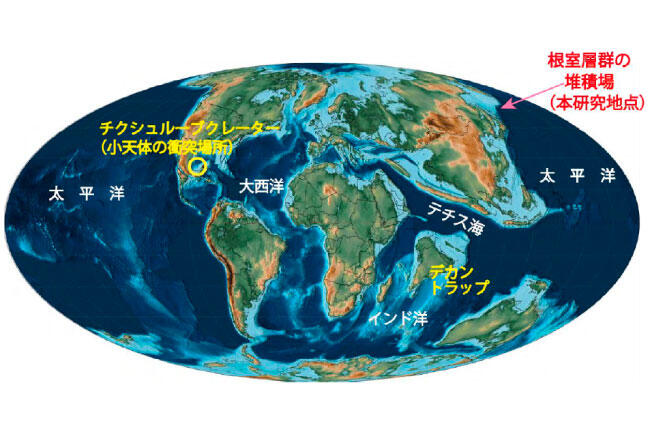
図 1. 白亜紀末期の古地理図と小惑星の衝突地点および本研究地点。Scotese (2014)の古地理図に加筆。
<関連情報>
東アジアにおけるチクシュルーブ衝突の痕跡 The Chicxulub impact signature in East Asia
Hayu Ota,Junichiro Kuroda,Keiichi Hayashi,Hiroyuki Hoshi,Ken Sawada,Kohei Hosogaya,Hiroshi Nishi,Akira Ishikawa,Katsuhiko Suzuki,Masashi A. Ikeda,Yuji Orihashi,Mark Schmitz,Babu Ram Gyawali,Hironao Matsumoto & Reishi Takashima
Nature Earth & Environment Published:20 May 2026
DOI:https://doi.org/10.1038/s43247-026-03602-z
Abstract
The Cretaceous-Paleogene boundary is defined by an asteroid impact at 66 million years ago at Chicxulub, Mexico. Despite extensive documentation worldwide, this boundary has not been clearly identified in East Asia, leaving a geographic gap in evaluating the global extent of impact records. Here we report a pronounced increase in osmium concentrations accompanied by a sharp decrease in 187Os/188Os ratios at the Kawaruppu section in the Nemuro Group, Hokkaido, Japan, which are indicative of the Chicxulub impact. These geochemical signatures are consistent with the zircon U–Pb age from an immediately overlying tuff layer, and supported by magnetostratigraphic and micropaleontological data. Iridium enrichment—a diagnostic impact marker— is subdued, suggesting partial stratigraphic gap, and the missing interval is estimated by box models to be approximately 30 thousand years. Nevertheless, our results identify a key stratigraphic horizon that enables paleoenvironmental correlation across the Cretaceous-Paleogene boundary in East Asia.