2026-05-20 ペンシルベニア州立大学(Penn State)
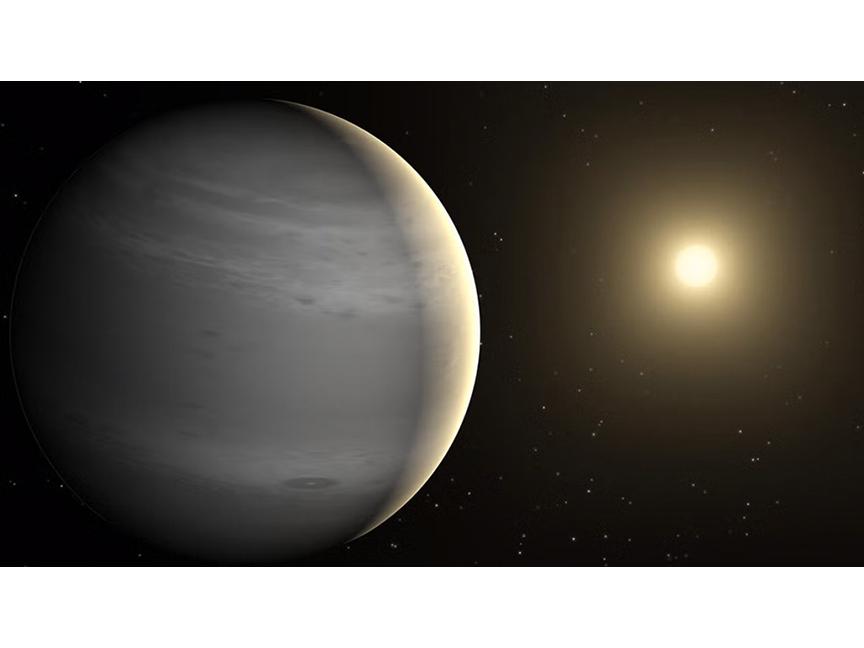
Artist’s impression of a gas giant planet orbiting its distant host star. New research, led by astronomers at Penn State and the Jet Propulsion Laboratory, used NASA’s James Webb Space Telescope to analyze the atmosphere of a gas giant planet about the size of Saturn but with Earth-like temperatures and found it to be rich in methane. Credit: NASA/JPL-Caltech. All Rights Reserved.
<関連情報>
- https://www.psu.edu/news/eberly-college-science/story/atmosphere-saturn-sized-planet-earth-temperature-contains-methane
- https://iopscience.iop.org/article/10.3847/1538-3881/ae4fba
温帯型系外土星TOI-199 bにおけるメタン Methane on the Temperate Exo-Saturn TOI-199 b
Aaron Bello-Arufe, Renyu Hu, Mantas Zilinskas, Jeehyun Yang, Armen Tokadjian, Luis Welbanks, Guangwei Fu, Michael Greklek-McKeon, Mario Damiano, Jonathan Gomez Barrientos,…
The Astronomical Journal Published: 2026 May 20
DOI:10.3847/1538-3881/ae4fba
Abstract
Temperate (Teq < 400 K) gas giants represent an unexplored frontier in exoplanet atmospheric spectroscopy. Orbiting a G-type star every ∼100 days, the Saturn-mass exoplanet TOI-199 b (Teq = 350 K) is one of the most favorable low-temperature gas giants for atmospheric study. Here, we present its transmission spectrum from a single transit observed with JWST’s NIRSpec G395M mode. Despite lower-than-nominal precision due to a pointing misalignment, the spectrum reveals the presence of CH4 (Bayes factor of ∼700 in a cloudy atmosphere), corresponding to a metallicity of C/H=13+78-12× solar, although the absence of detectable CO and CO2 at the current precision disfavors metallicities ≳50 × solar. We also tested several haze prescriptions (Titan-like tholin, soot, and water-rich tholin), but the preference for these models is weak (Bayes factors of ∼2 relative to the clear case). The spectrum also shows an increase in transit depth near 3 μm, which our self-consistent models attribute to either NH3 or, less likely, HCN. Follow-up observations could distinguish between these species, helping determine the planet’s vertical mixing regime. The TOI-199 system exhibits strong transit timing variations (TTVs) due to an outer non-transiting giant planet. For planet c, our TTV analysis reduces its mass uncertainty by 50% and prefers a slightly longer orbital period (but still within the conservative habitable zone) and higher eccentricity relative to previous studies. TOI-199 b serves as the first data point for studying clouds and hazes in temperate gas giants, with the detection of spectral features in its transmission spectrum indicating that temperate gas giants are promising targets for detailed atmospheric characterization.