
2026-04-30 京都大学
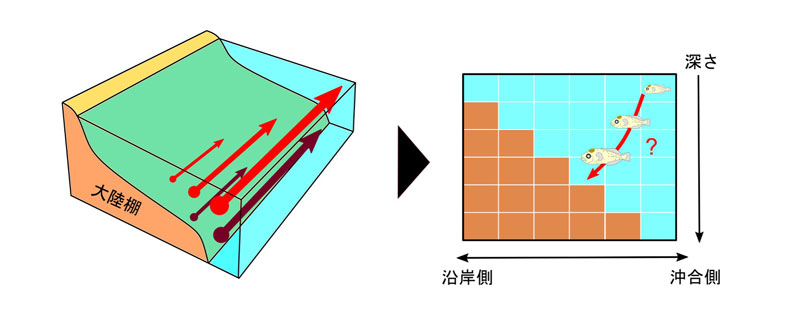
階段チャート解析の概要:大陸棚上の海洋環境を数枚の断面に圧縮し、その中での魚の動きを捉える。(作成:坂本達也)
<関連情報>
- https://www.kyoto-u.ac.jp/ja/research-news/2026-04-30
- https://onlinelibrary.wiley.com/doi/10.1111/fog.70045
階段図:マアジへの応用例:幼魚の垂直方向および横断方向の移動と分散の可視化 The Staircase Chart: Visualising Vertical and Cross-Shelf Movements and Dispersal of Early-Life Fish, Applied to Japanese Jack Mackerel
Tatsuya Sakamoto, Daichi Muto, Motomitsu Takahashi, Chiyuki Sassa, Toyoho Ishimura
Fisheries Oceanography Published: 29 April 2026
DOI:https://doi.org/10.1111/fog.70045
ABSTRACT
Dispersal during early life stages is a critical process shaping marine fish connectivity and population dynamics, yet direct field observations at the individual level remain elusive. This has limited our understanding of the factors controlling dispersal, including the impact of active swimming by larvae and juveniles. Here, we present a new method to reconstruct ontogenetic vertical and horizontal movements of fish on continental shelves by integrating high-resolution otolith oxygen isotope profiles, hydrodynamic models and a hidden Markov model. The shelf environment was compressed into a representative cross-section, referred to as the ‘staircase chart,’ where fish trajectories were inferred by matching otolith isotopes with modelled hydrographic conditions. Applying this to shelf-spawning Japanese jack mackerel Trachurus japonicus in the East China Sea revealed general ontogenetic vertical migrations and variable cross-shelf movements. Most individuals originated on the southern outer shelf influenced by the Kuroshio current, but those that showed faster growth during the first 30 days from hatch moved earlier to the inner shelf and remained south, while others stayed on the outer shelf and were advected northward. These findings demonstrate that horizontal movements, potentially reflecting active swimming, play an important role in retention and dispersal from shelf-edge spawning grounds. This newly developed framework offers a powerful tool to advance mechanistic understanding of marine fish dispersal and inform conservation and management in shelf ecosystems.
