2026-04-27 マサチューセッツ工科大学(MIT)
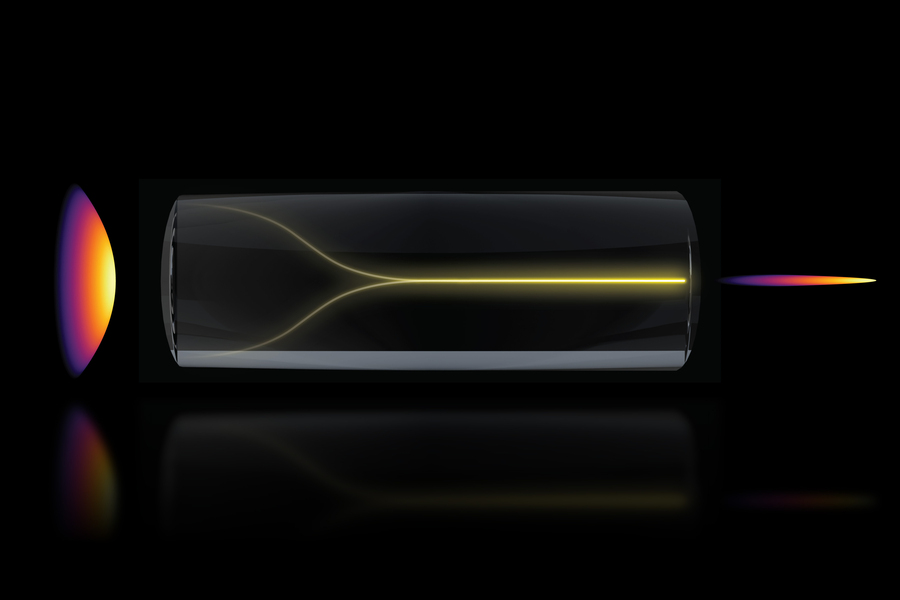
Under the right conditions, a chaotic mess of laser light can spontaneously self-organize into a highly focused “pencil beam.” This schematic shows the pencil beam formation mechanism.Credits:Image: Courtesy of the researchers
<関連情報>
- https://news.mit.edu/2026/self-organizing-pencil-beam-laser-could-help-scientists-design-brain-targeted-therapies-0427
- https://www.nature.com/articles/s41592-026-03067-0
体積多光子イメージングのための自己局在型超高速ペンシルビーム Self-localized ultrafast pencil beam for volumetric multiphoton imaging
Honghao Cao,Sarah Spitz,Li-Yu Yu,Kunzan Liu,Zhengyu Zhang,Federico Presutti,Francesca Michela Pramotton,Subhash Kulkarni,Roger D. Kamm & Sixian You
Nature Methods Published:27 April 2026
DOI:https://doi.org/10.1038/s41592-026-03067-0
Abstract
The formation of organized optical states in multidimensional systems is crucial for understanding light–matter interaction and advancing light-shaping technologies. Here we report the observation of a self-localized, ultrafast pencil beam near the critical power in a standard multimode fiber. We demonstrate that self-focusing, traditionally considered detrimental, facilitates a nonlinear spatiotemporal localized state with a sidelobe-suppressed Bessel-like profile and markedly improved stability. Generated simply by an on-axis Gaussian launch, this beam is readily integrated into standard multiphoton microscopes. We applied this self-localized beam to two-photon imaging of mouse enteric nervous systems, where it outperformed conventional Bessel beams through reduced sidelobes and enhanced aberration resilience. Lastly, we monitored transferrin uptake dynamics in a live human blood–brain barrier model using minute-resolved three-dimensional scans, revealing spatiotemporal heterogeneity across different cell types. Our findings offer a robust approach for generating ultrafast pencil beams, enabling high-throughput three-dimensional biosystem imaging to elucidate biological transport pathways.