2026-04-23 パシフィック・ノースウェスト国立研究所(PNNL)
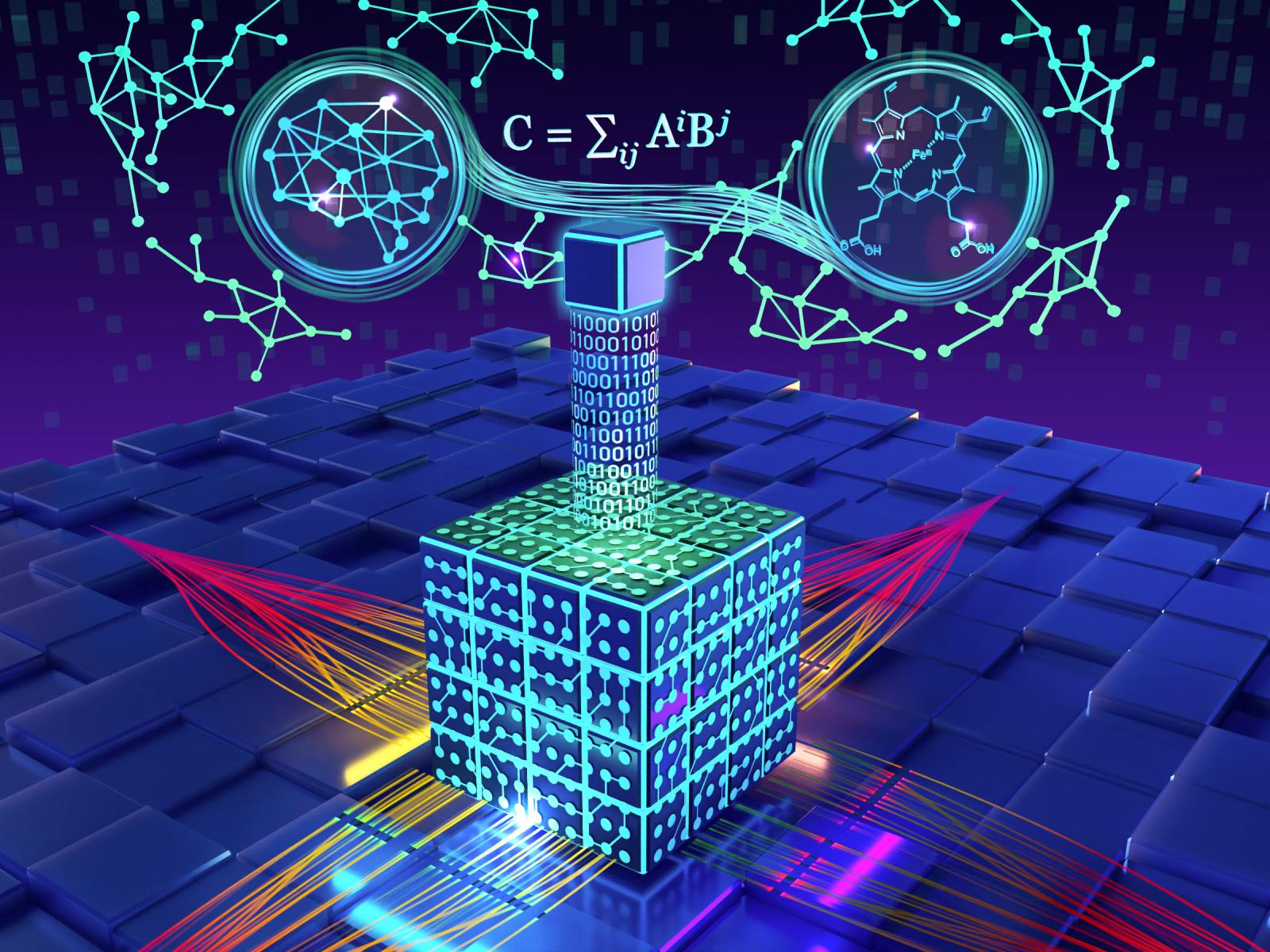
Quantum chemistry meets AI by emulating FP64 arithmetic through the use of mixed precision compute resources on graphic processing unit-accelerated hardware.(Image by Nathan Johnson | Pacific Northwest National Laboratory)
<関連情報>
- https://www.pnnl.gov/news-media/ai-accelerators-deliver-accurate-models-challenging-quantum-chemistry-calculations
- https://pubs.acs.org/doi/10.1021/acs.jctc.6c00203
エミュレートされたFP64演算を介してNVIDIA Blackwellテクノロジーに適合させた混合精度Ab Initioテンソルネットワーク状態メソッド Mixed-Precision Ab Initio Tensor Network State Methods Adapted for NVIDIA Blackwell Technology via Emulated FP64 Arithmetic
Cole Brower,Samuel Rodriguez Bernabeu,Jeff Hammond,John Gunnels,Sotiris S. Xantheas,Martin Ganahl,Andor Menczer,and Örs Legeza
Journal of Chemical Theory and Computation Published: April 20, 2026
DOI:https://doi.org/10.1021/acs.jctc.6c00203
Abstract
We report cutting-edge performance results via mixed-precision spin-adapted ab initio density matrix renormalization group (DMRG) electronic structure calculations utilizing the Ozaki scheme for emulating FP64 arithmetic through the use of fixed-point compute resources. By approximating the underlying matrix and tensor algebra with operations on a modest number of fixed-point representatives (“slices”), we demonstrate on smaller benchmark systems and for the active compounds of the FeMoco and cytochrome P450 (CYP) enzymes with complete active space (CAS) sizes of up to 113 electrons in 76 orbitals [CAS(113, 76)] and 63 electrons in 58 orbitals [CAS(63, 58)], respectively, that milli-Hartree accuracy can be reached with mixed-precision arithmetic. We also show that, due to its variational nature, DMRG provides an ideal tool to benchmark accuracy domains, as well as the performance of new hardware developments and related numerical libraries. Detailed numerical error analysis and performance assessment are also presented for subcomponents of the DMRG algebra by systematically interpolating between double- and pseudo-half-precision. Our analysis represents the first quantum chemistry evaluation of FP64 emulation for correlated calculations capable of achieving even chemical accuracy and emulation based on fixed-point arithmetic, and it paves the way for the utilization of state-of-the-art Blackwell technology in tree-like tensor network state electronic structure calculations, opening new research directions in materials sciences and beyond.