2026-04-23 京都大学
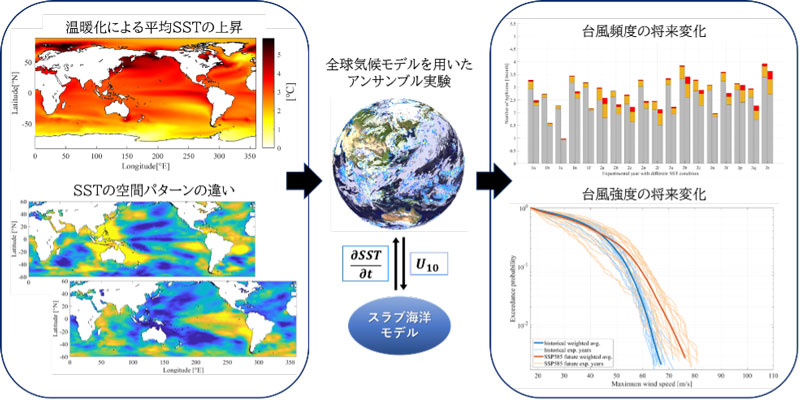
台風特性の将来変化に関する本研究の概念図
<関連情報>
- https://www.kyoto-u.ac.jp/ja/research-news/2026-04-23
- https://www.kyoto-u.ac.jp/sites/default/files/2026-04/web_2604_Mori-aa337aac0b5129622976b9ff90f387fc.pdf
- https://journals.ametsoc.org/view/journals/clim/39/10/JCLI-D-25-0274.1.xml
スラブ海洋結合型MRI-AGCMによる固定SSTアンサンブル実験に基づく将来の台風特性変化の確率的評価 Probabilistic Assessments on Future Changes in Typhoon Characteristics Based on Fixed-SST Ensemble Experiments by Slab-Ocean Coupled MRI-AGCM
Yoshiki Matsuo,Tomoharu Okada,Tomoya Shimura,Nobuhito Mori,Takuya Miyashita, andRyo Mizuta
Journal of Climate Published:16 Apr 2026
DOI:https://doi.org/10.1175/JCLI-D-25-0274.1
Abstract
Probabilistic assessments of future changes in typhoon characteristics, which are necessary for coastal protection and climate change adaptation, have not been sufficiently conducted. This study probabilistically demonstrated the variability and future changes in typhoon intensity and frequency. Given that the variability of typhoon characteristics is related to sea surface temperature (SST) spatial patterns, we propose new large-ensemble simulations for typhoons under several sea surface boundary conditions based on the slab-ocean coupled atmospheric global climate model [Meteorological Research Institute Atmospheric General Circulation Model (MRI-AGCM)]. This study evaluated the relationship between the spatial patterns of SST and the corresponding typhoon intensity. Climate simulations were performed under historical and future conditions [the shared socioeconomic pathway (SSP) 5-8.5 scenario] to quantify future changes in typhoon characteristics. For quantitative evaluations of typhoon frequency and intensity, the weight-averaged number of typhoons in September decreased by 22% and 27% in the future projection with 60- and 20-km resolutions, respectively, compared to the historical simulation. The annual probability of occurrence for typhoons, which ranked in the top 1% in historical simulations, is projected to increase to 4%–5% under the SSP5-8.5 future climate conditions. The variance in typhoon intensity is larger in the future projection, which can be explained by approximately 50%–60% of the SST pattern differences and future increments in mean SST. As the exceedance probability of typhoon intensity decreases, the contribution of climate change to its variance becomes more pronounced. A comparison of the historical and future simulations shows that typhoon intensity becomes more sensitive to the trend of ENSO patterns in the future.
Significance Statement
Climate change can alter the long-term characteristics of typhoon. Existing typhoon projection studies lack adequate representation of typhoons in global climate models and probabilistic evaluation of natural variability. This study addressed these gaps by proposing a large-ensemble climate experiment using a high-resolution atmospheric global climate model optimized for typhoon simulations. By varying sea surface temperature (SST) conditions, we conducted a probabilistic evaluation of future changes in typhoon intensity and frequency. Typhoon frequency would decrease, but extreme-intensity events would increase. The projected variability in typhoon intensity is explained by approximately 60% through a combination of SST spatial pattern differences and future mean SST increases. This approach provides a robust framework for uncertainty quantification and targeted climate risk assessment.