2026-04-07 中国科学院(CAS)
<関連情報>
- https://english.cas.cn/newsroom/research-news/202604/t20260407_1155354.shtml
- https://link.springer.com/article/10.1007/s11104-026-08434-6
ホルチン砂漠南部縁辺部における、復元された砂漠化草原の安定化に対する在来植生配置の影響 Effects of native vegetation configuration on the stabilization of restored desertified grassland in the Southern Margin of Horqin Sandy Land
Chi Zhang,Haitao Wang,Lei Chu,Jing Wu,Jianqiang Qian,Yongcui Wang & Lixin Wang
Plant & Soil Published:03 March 2026
DOI:https://doi.org/10.1007/s11104-026-08434-6
Abstract
Aims
Grassland desertification is a major threat to ecosystem functioning in semi-arid regions. However, the most effective configurations of native vegetation for restoring aboveground plant communities and soil seed banks across degradation stages remain poorly understood. This study aimed to determine: (i) how native vegetation configurations affect aboveground community structure along a desertification gradient, and (ii) their potential to improve the community structure of restored desertified grassland.
Methods
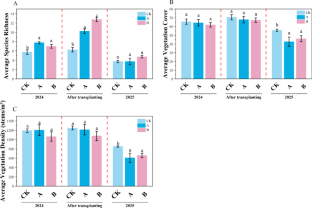
We established study plots in the Zhanggutai area in lightly, moderately, and severely desertified grasslands. Treatments included an unplanted control and two native species-addition treatments using locally vegetation seedlings. Aboveground species richness, cover, and density were monitored in 2024 and 2025. Soil seed banks were characterized using the seedling emergence method from 0–5 cm soil cores. We calculated diversity indices (Shannon–Wiener, Simpson, Pielou’s evenness, Patrick richness) and Sørensen similarity index.
Results
The effectiveness of native species addition was dependent on the initial desertification stage. The most pronounced and sustained improvements in aboveground richness, cover, and density were observed in moderately desertified grasslands. While soil seed bank diversity increased gradually, the Sørensen similarity between the aboveground vegetation and the seed bank increased significantly under the restoration treatments, particularly in moderately desertified grasslands, associated with the incorporation of species such as Lespedeza davurica and Allium ramosum.
Conclusions
Our results identify moderately desertified grasslands as a critical and responsive stage for restoration. At this stage, near-natural vegetation configurations can rapidly enhance community structure and strengthen the linkage between the vegetation and the soil seed bank.