2026-04-02 合肥物質科学研究院(HFIPS)
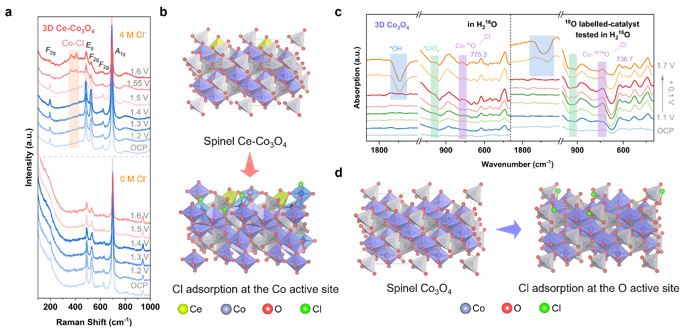
Schematic illustration of active-site transformation in the 3D Ce-Co3O4 catalyst (Image by YIN Huajie)
<関連情報>
- https://english.hf.cas.cn/nr/rn/202604/t20260402_1155067.html
- https://www.nature.com/articles/s41467-026-70443-x
スピネル型Co₃O₄におけるセリウム駆動による活性部位の再配置により、酸性媒体中での安定した塩素発生が可能になる Cerium driven active site relocation in spinel Co3O4 enables stable chlorine evolution in acidic media
Zhixian Mao,Jifang Zhang,Tengxiu Tu,Xiangyang Li,Jiapeng Ji,Pengqi Yang,Yongying Tian,Shengbo Zhang,Tongfei Shi,Shan Chen,Porun Liu,Haimin Zhang,Huajie Yin & Huijun Zhao
Nature Communications Published:10 March 2026
DOI:https://doi.org/10.1038/s41467-026-70443-x Unedited version
Abstract
The chlorine evolution reaction underpins the chlor-alkali industry, yet its harsh acidic oxidative environment severely limits the stability of non-noble catalysts. Here we show that atomically dispersed Ce in spinel Co3O4 with a three-dimensional ordered macroporous nanostructure triggers active site relocation from lattice oxygen to cobalt, simultaneously enhancing activity and inhibiting lattice oxygen corrosion. Ce occupies octahedral Co sites, inducing polyhedral distortion and creating unsaturated Co Centers that directly adsorb Cl⁻. In 4 M NaCl at pH = 2, the catalyst achieves overpotentials of 44 and 218 mV at 10 and 1000 mA cm–2, respectively, with ~99.1% chlorine selectivity and robust durability over 550 h in a chlor-alkali cell at 2.5 kA m–2. In situ Raman, attenuated total reflection surface-enhanced infrared absorption spectroscopy and differential electrochemical mass spectrometry confirm the active-site transformation, while density functional theory calculations reveal optimized Cl adsorption free energy, suppressed oxygen-mediated degradation, and preserved structural integrity. This active-site engineering strategy offers a route to designing stable, high-current-density catalysts for chlorine production beyond noble metals.