2026-03-17 チャルマース工科大学
<関連情報>
- https://news.cision.com/chalmers/r/superconductor-advance-could-unlock-ultra-energy-efficient-electronics,c4319769
- https://www.nature.com/articles/s41467-025-67500-2
ナノファセット基板を用いた超薄型YBa₂Cu₃O₇− δ膜の超伝導性の向上 Boosting superconductivity in ultrathin YBa2Cu3O7−δ films via nanofaceted substrates
Eric Wahlberg,Riccardo Arpaia,Debmalya Chakraborty,Alexei Kalaboukhov,David Vignolles,Cyril Proust,Annica M. Black-Schaffer,Thilo Bauch,Götz Seibold & Floriana Lombardi
Nature Communications Published:07 January 2026
DOI:https://doi.org/10.1038/s41467-025-67500-2
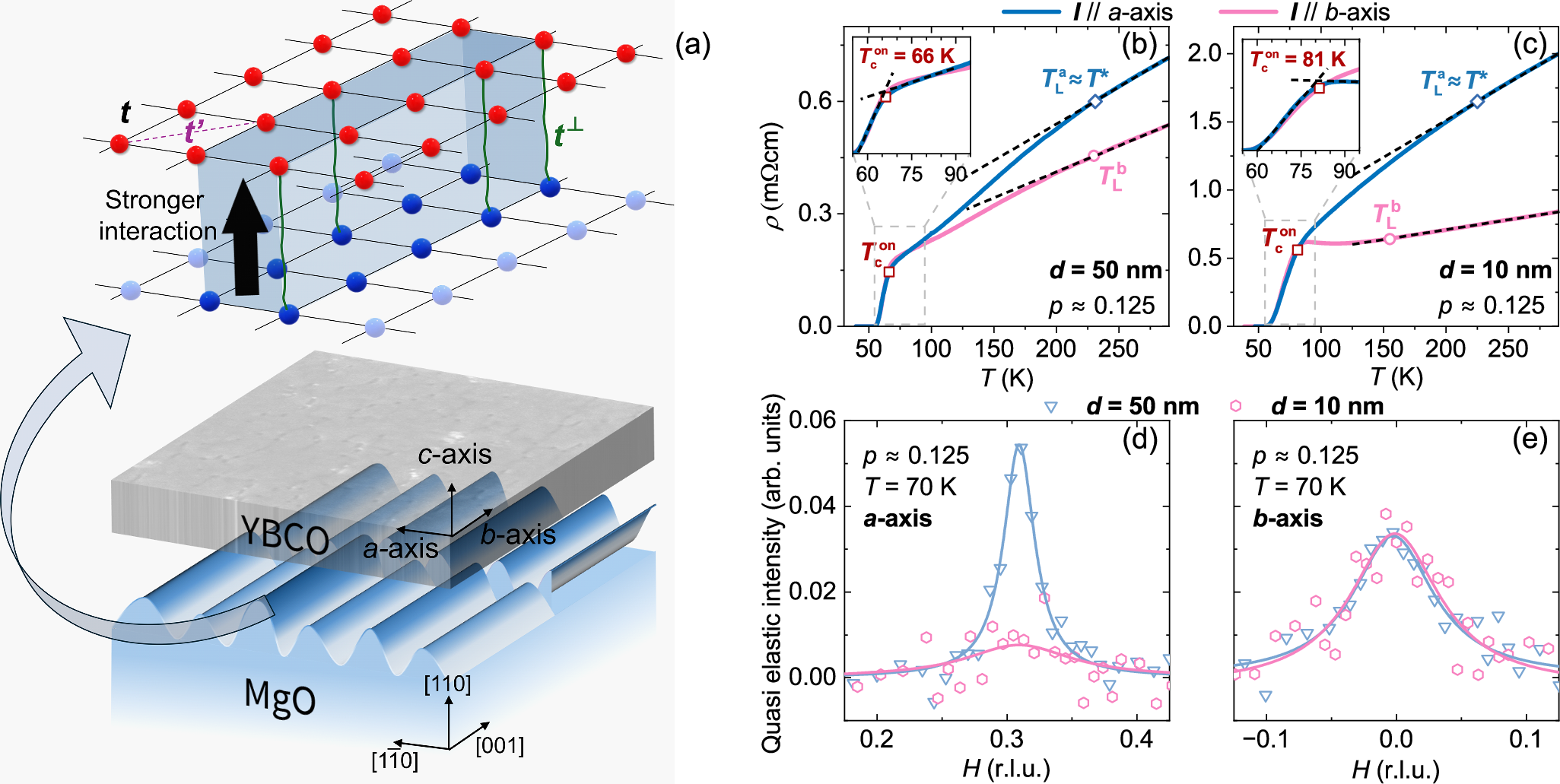
Abstract
In cuprate high-temperature superconductors the doping level is fixed during synthesis, hence the charge carrier density per CuO2 plane cannot be easily tuned by conventional gating, unlike in 2D materials. Strain engineering has recently emerged as a powerful tuning knob for manipulating the properties of cuprates, in particular charge and spin orders, and their delicate interplay with superconductivity. In thin films, additional tunability can be introduced by the substrate surface morphology, particularly nanofacets formed by substrate surface reconstruction. Here we show a remarkable enhancement of the superconducting onset temperature Tonc and the upper critical magnetic field Hc,2 in nanometer-thin YBa2Cu3O7−δ films grown on a substrate with a nanofaceted surface. We theoretically show that the enhancement is driven by electronic nematicity and unidirectional charge density waves, where both elements are captured by an additional effective potential at the interface between the film and the uniquely textured substrate. Our findings show a new paradigm in which substrate engineering can effectively enhance the superconducting properties of cuprates. This approach opens an exciting frontier in the design and optimization of high-performance superconducting materials.