2026-02-27 中国科学院(CAS)
<関連情報>
- https://english.cas.cn/newsroom/research-news/202603/t20260302_1151352.shtml
- https://www.nature.com/articles/s43247-026-03224-5
- https://www.tandfonline.com/doi/full/10.1080/15481603.2025.2610841
中国南部における5世紀にわたるトウモロコシ栽培と森林崩壊 Maize cultivation and forest collapse over five centuries in southern China
Yuemin Yue,Shuai Yuan,Lu Wang,Xiudong Hao,Jun Lu,Qian Li,Xinbao Zhang,Xuhong Ouyang,Hongyan Liu,Houyuan Lu,Deliang Chen,Xiangming Xiao,Kelin Wang,Rasmus Fensholt & Martin Brandt
Communications Earth & Environment Published:23 January 2026
DOI:https://doi.org/10.1038/s43247-026-03224-5
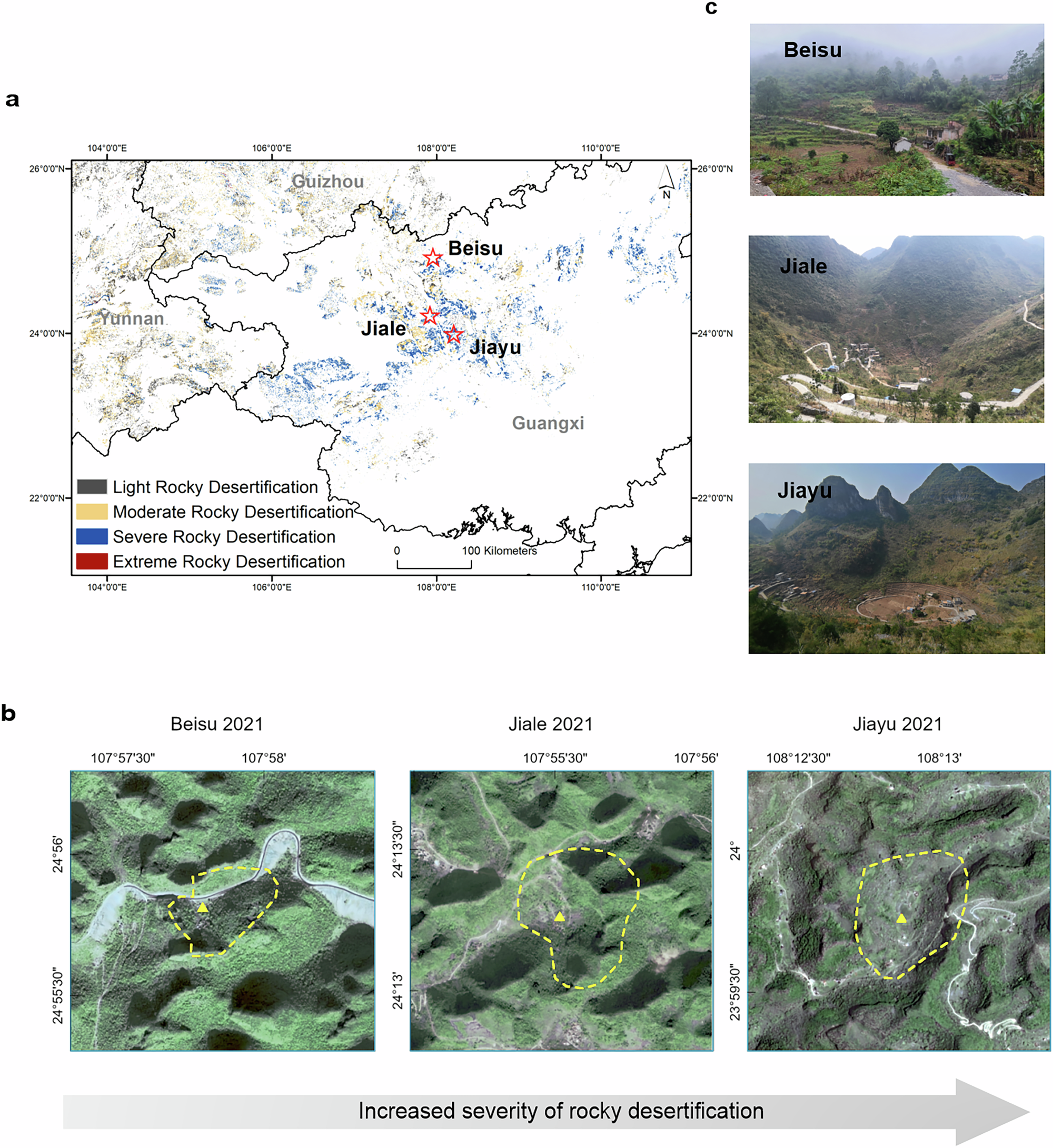
Abstract
A lack of historical land-use data hinders the appropriate assessment of ecosystem restoration potential. Here we integrate pollen and phytolith analysis, isotopic dating, historical records, and high-resolution satellite imagery to reconstruct five centuries of land-use and vegetation change in the karst landscapes of Southwest China. We show that prior to the 18th century, dense forests dominated the region under minimal human influence. However, the introduction of maize cultivation, rapid population growth, and extensive deforestation triggered a persistent shift toward open landscapes. This transformation is evidenced by a marked rise in pioneer fern spores (~11%) and an increase in herb pollen by 3.7–18.8%. In areas with severe historical human disturbance, ecological recovery remains difficult, and tree numbers have remained nearly unchanged over the past two decades, despite the absence of human intervention. Overlooking these historical land-use legacies in restoration efforts may possibly lead to unrealistic expectations, misguided interventions, and wasted resources.
中国南西部のカルスト林では、人為的撹乱の激しさにより、回復を遅らせることなく干ばつ耐性が低下している Human disturbance intensity reduces drought resistance without prolonging recovery in karst forests of southwest China
Lu Wang,Yuemin Yue,Liang Shi,Weiye Wang,Jiawen Cui,Qian Li, …
GIScience & Remote Sensing Published:04 Jan 2026
DOI:https://doi.org/10.1080/15481603.2025.2610841
Abstract
Role of human disturbance in shaping forest drought responses remains insufficiently understood, particularly in widely-distributed and ecologically-fragile karst landscapes. Here, we analyzed six major drought events over the past two decades in the karst forests of Southwest China, a region representative of tropical and subtropical karst ecosystems with intensive human activity. Using high-resolution gross primary productivity (GPP) and Standardized Precipitation Evapotranspiration Index (SPEI) datasets, we compared drought resistance and recovery time between low- and high-disturbance forests. High-disturbance forests experienced significantly greater maximum GPP losses during droughts, with differences reaching up to 13% under comparable drought intensities. Beyond the dominant influence of drought intensity, climatic conditions (temperature and precipitation) and soil factors (soil organic carbon and soil thickness) exerted stronger effects on drought-induced GPP loss in high-disturbance forests than in low-disturbance ones. Interestingly, despite suffering greater productivity loss, high-disturbance forests exhibited comparable, and occasionally even shorter, recovery times than low-disturbance forests, suggesting a possible trade-off between drought resistance and recovery capacity. Although recovery time was not consistently prolonged, the greater productivity losses and elevated climatic and edaphic sensitivity in high-disturbance forests indicate reduced resistance and heightened vulnerability to future climate extremes and progressive drying trends.