2026-03-03 ペンシルベニア州立大学(Penn State)
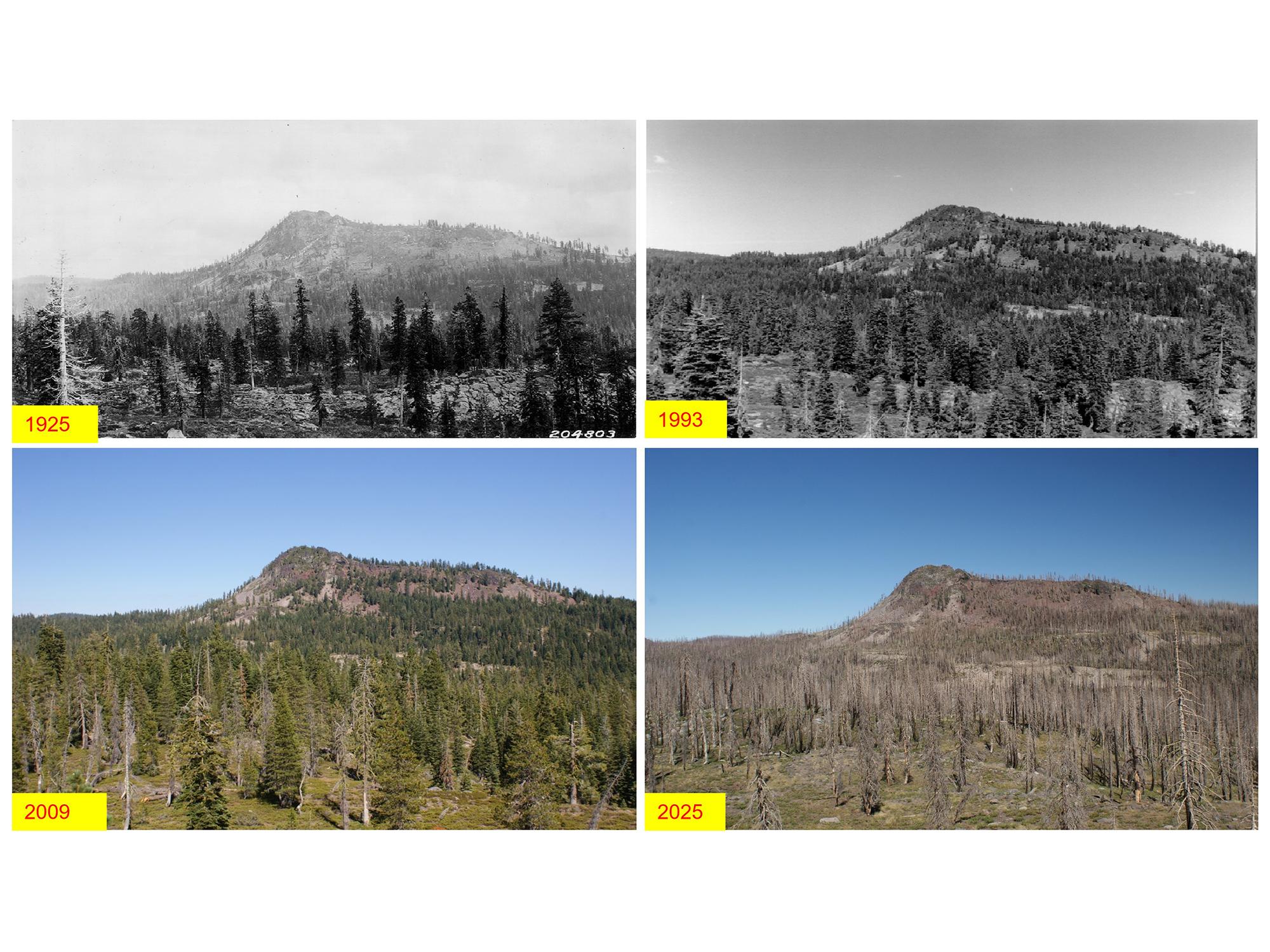
This series of photographs taken from the same location in Lassen Volcanic National Park over a period of 100 years shows how forests thickened due to fire exclusion and then burned severely in the 2021 Dixie, in part, due to the much higher fuel load. Penn State researchers are continuing to study how the forest will recover after a series of wildfires. Credit: Wieslander US Forest Service (1925), Alan Taylor. All Rights Reserved.
<関連情報>
- https://www.psu.edu/news/earth-and-mineral-sciences/story/forest-exhibits-resilience-after-california-mega-fire
- https://www.sciencedirect.com/science/article/abs/pii/S0378112725009259
米国カリフォルニア州ラッセン火山国立公園の再燃焼における再生避難所に寄与する要因 Factors contributing to regeneration refugia in reburns, Lassen Volcanic National Park California, USA.
Dani Niziolek, Alan H. Taylor, Lucas B. Harris
Forest Ecology and Management Available online: 10 December 2025
DOI:https://doi.org/10.1016/j.foreco.2025.123417
Highlights
- Tree regeneration was sampled before and after a reburn.
- Regeneration persisted in 32 % of plots after the wildfire
- Distance to forest, slope, fire history, and fuel consumption explain persistence.
- Fuel reduction at forest edges would promote persistence through reburns.
Abstract
Large wildland fires are becoming frequent in the western USA, and areas burned more than once (reburns) are increasingly common. Tree regeneration is a common metric used in post-fire forest management, yet investigations of regeneration fate through reburns are rare. Here, we examine factors that contribute to regeneration refugia, or locations in reburns that permit survival of tree regeneration through a reburn, and identify changes in biological legacies from earlier fires between 1984 and 2012 that could affect new post-reburn regeneration. We quantified post-fire tree regeneration and understory and fuel conditions in 2019 and 2021, and again in 2022 in Lassen Volcanic National Park, California, following the 2021 Dixie fire reburn. Regeneration persisted in almost 1/3 of 100 m2 plots, with 19 % of all stems surviving the Dixie fire. Logistic regression models of regeneration refugia were developed considering both pre- and post-reburn conditions. A model of pre-reburn factors indicated the importance of landscape characteristics and legacies of previous fire, showing that regeneration persistence increased with slope, topographic wetness and pre-fire distance to forest, and decreased with previous fire severity. A full model including post-reburn factors indicated that fuel consumption was the most important determinant of regeneration refugia. However, legacy variables of distance to intact forest, fire severity, and pre-fire fuel load were also important, along with slope. Management action in reburn landscapes including fuel reduction at forest edges, in high severity burn areas, and on steep slopes may buffer regeneration refugia from fire effects in subsequent reburns.