2025-07-21 中国科学院(CAS)
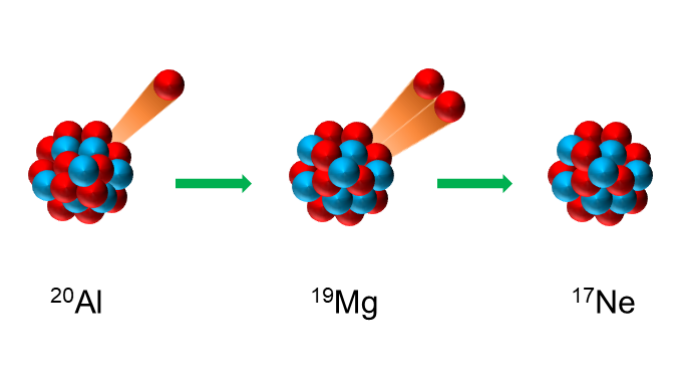
Illustration of three-proton emission from aluminium-20. (Image by XU Xiaodong)
<関連情報>
- https://english.cas.cn/newsroom/research_news/phys/202507/t20250721_1047700.shtml
- https://journals.aps.org/prl/abstract/10.1103/hkmy-yfdk
3陽子放出核の崩壊に見られるアイソスピン対称性の破れ20 Al Isospin Symmetry Breaking Disclosed in the Decay of Three-Proton Emitter 20Al
X.-D. Xu, I. Mukha, J. G. Li, S. M. Wang, L. Acosta, M. Bajzek, E. Casarejos, D. Cortina-Gil, J. M. Espino et al.
Physical Review Letters Published: 10 July, 2025
DOI: https://doi.org/10.1103/hkmy-yfdk
Abstract
The previously unknown nucleus 20Al has been observed for the first time by detecting its in-flight decays. Tracking trajectories of all decay products with silicon microstrip detectors allowed for a conclusion that 20Al is unbound with respect to three-proton (3) emission. The 3-decay energy of the 20Al ground state has been determined to be 1.93(+0.12−0.10) MeV through a detailed study of angular correlations of its decay products, 17Ne+++. This value is significantly smaller than the predictions inferred from the isospin symmetry by using the known neutron separation energy of its mirror nucleus 20N, which indicates a possible isospin symmetry breaking in the mirror nuclei 20Al and 20N. This observed isospin symmetry breaking is supported by the calculations of the continuum embedded theoretical frameworks, describing the observed 20Al ground state as a 1 -wave state with a spin-parity of 1−, which differs from the spin-parity (2−) of the 20N ground state. The 20Al ground state decays by sequential 1−2 emission via the intermediate ground state of 19Mg, which is the first observed case of “daughter” 2 radioactivity following 1 decay of the parent state.