
2025-12-11 NASA
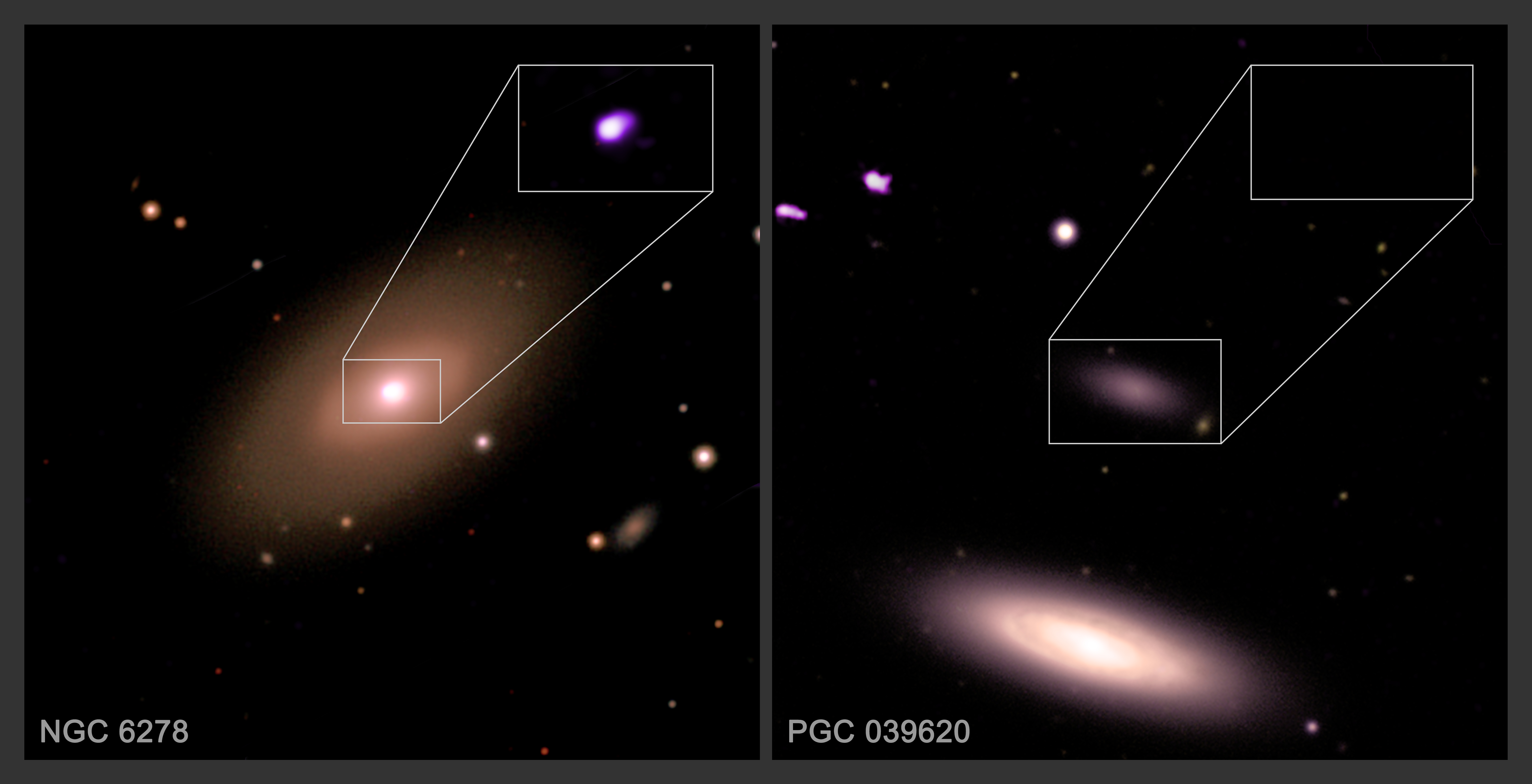
NGC 6278 and PGC 039620 are two galaxies from a sample of 1,600 that were searched for the presence of supermassive black holes. These images represent the results of a study that suggests that smaller galaxies do not contain supermassive black holes nearly as often as larger galaxies do. The study analyzed over 1,600 galaxies that have been observed with Chandra over two decades. Certain X-ray signatures indicate the presence of supermassive black holes. The study indicates that most smaller galaxies like PGC 03620, shown here in both X-rays from Chandra and optical light images from the Sloan Digital Sky Survey, likely do not have supermassive black holes in their centers. In contrast, NGC 6278, which is roughly the same size as the Milky Way, and most other large galaxies in the sample show evidence for giant black holes within their cores.X-ray: NASA/CXC/SAO/F. Zou et al.; Optical: SDSS; Image Processing: NASA/CXC/SAO/N. Wolk
<関連情報>
- https://www.nasa.gov/missions/chandra/nasas-chandra-finds-small-galaxies-may-buck-the-black-hole-trend/
- https://arxiv.org/abs/2510.05252
中心大質量ブラックホールは局所低質量銀河に普遍的に存在するわけではない Central Massive Black Holes Are Not Ubiquitous in Local Low-Mass Galaxies
Fan Zou, Elena Gallo, Anil C. Seth, Edmund Hodges-Kluck, David Ohlson, Tommaso Treu, Vivienne F. Baldassare, W. N. Brandt, Jenny E. Greene, Piero Madau, Dieu D. Nguyen, Richard M. Plotkin, Amy E. Reines, Alberto Sesana, Jong-Hak Woo, Jianfeng Wu
arXiv Submitted on 6 Oct 2025
DOI:https://doi.org/10.48550/arXiv.2510.05252
Abstract
The black-hole occupation fraction (focc) defines the fraction of galaxies that harbor central massive black holes (MBHs), irrespective of their accretion activity level. While it is widely accepted that focc is nearly 100% in local massive galaxies with stellar masses M⋆ ≳ 1010 M⊙, it is not yet clear whether MBHs are ubiquitous in less-massive galaxies. In this work, we present new constraints on focc based on over 20 years of Chandra imaging data for 1606 galaxies within 50 Mpc. We employ a Bayesian model to simultaneously constrain focc and the specific accretion-rate distribution function, p(λ), where the specific accretion rate is defined as λ = LX/M⋆, and LX is the MBH accretion luminosity in the 2-10 keV range. Notably, we find that p(λ) peaks around 1028 erg s−1 M−1 ⊙ ; above this value, p(λ) decreases with increasing λ, following a power-law that smoothly connects with the probability distribution of bona-fide active galactic nuclei. We also find that the occupation fraction decreases dramatically with decreasing M⋆: in high mass galaxies (M⋆ ≈ 1011−12 M⊙), the occupation fraction is > 93% (a 2σ lower limit), and then declines to 66+8 −7% (1σ errors) between M⋆ ≈ 109−10M⊙, and to 33+13 −9 % in the dwarf galaxy regime between M⋆ ≈ 108−9 M⊙. Our results have significant implications for the normalization of the MBH mass function over the mass range most relevant for tidal disruption events, extreme mass ratio inspirals, and MBH merger rates that upcoming facilities are poised to explore

