
2026-11-11 東京科学大学
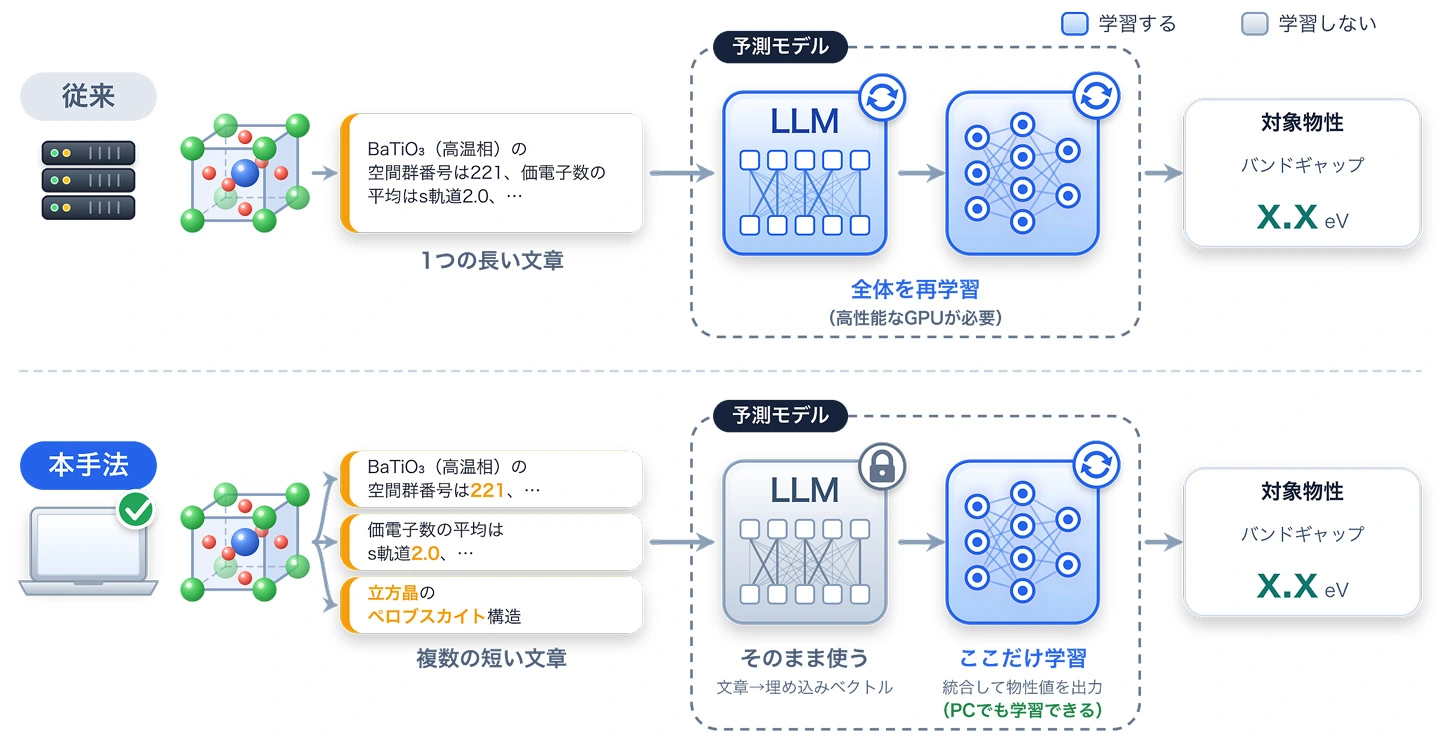
図1. ZEBRA-Propの学習過程の概略図。点線内が予測モデルであり、あらかじめ物性値が既知である大量のデータを学習することで構築される。従来手法(上)はLLMを含む全体を学習するが、本手法(下)は後段の小規模なニューラルネットワークだけを学習するため、学習が格段に高速化されている。ここではバンドギャップを対象物性とし、BaTiO3(チタン酸バリウム)の高温相を例として示している。
<関連情報>
- https://www.isct.ac.jp/ja/news/ps2kccai8nk0
- https://advanced.onlinelibrary.wiley.com/doi/10.1002/aisy.70592
ZEBRA-Prop:ゼロショット埋め込みに基づく、高速で使いやすい材料物性回帰モデル ZEBRA-Prop: A Zero-Shot Embedding-Based Rapid and Accessible Regression Model for Materials Properties
Ryoma Yamamoto, Akira Takahashi, Kei Terayama, Yu Kumagai, Fumiyasu Oba
Advanced Intelligent Systems Published: 10 November 2026
DOI:https://doi.org/10.1002/aisy.70592
Abstract
Large language models (LLMs) exhibit substantial potential across diverse scientific disciplines, including materials science. A property prediction framework, ZEBRA-Prop (Zero-Shot Embedding-Based Rapid and Accessible Regression Model for Materials Properties), is presented here as an extension of LLM-Prop. In contrast to LLM-Prop, which requires task-specific fine-tuning of the LLM, ZEBRA-Prop keeps the text encoder frozen and eliminates task-specific fine-tuning of the LLM, thereby reducing computational cost and enabling rapid model training. The framework employs MatBERT, a language model pretrained on materials science literature, to enhance predictive capability. Multiple textual embeddings are incorporated through a learnable weighting mechanism, which alleviates the context-length constraints inherent in LLM-Prop and facilitates effective integration of diverse textual representations. Evaluation is conducted using two datasets: the TextEdge dataset (~140,000 entries) and an in-house dataset (~2000 entries) derived from the Materials Project database, with physical properties obtained from first-principles calculations. The predictive performance of ZEBRA-Prop is close to that of LLM-Prop, while the training time is reduced by approximately 95%. The performance improvements are attributable to three principal factors: domain-specific LLM utilization, diversified textual descriptions, and systematic text preprocessing. ZEBRA-Prop is a scalable, computationally efficient framework that supports accelerated materials discovery, particularly under limited computational resources.

