2026-10-19 ローレンス・バークレー国立研究所(LBNL)
<関連情報>
- https://newscenter.lbl.gov/2026/10/19/a-simple-blood-test-could-reveal-hidden-radiation-exposure/
- https://www.nature.com/articles/s43856-026-01690-8
マウスモデルにおける機械学習による放射線被ばくの予測的血液学的バイオマーカーの特定 Identifying predictive hematological biomarkers for radiation exposure by machine learning in mouse models
Hang Chang, Yiyan Yao, Jared DeChant, Lieselotte Obst-Huebl, Kenneth H. Wan, Soo Park, William Fisher, Kei Nakamura, Susan E. Celniker, Antoine M. Snijders, Jian-Hua Mao & Jamie L. Inman
Communications Medicine Published:19 June 2026
DOI:https://doi.org/10.1038/s43856-026-01690-8
Abstract
Background
Population-scale radiation exposure assessment during radiological emergencies is hindered by the slow and costly nature of current methods, creating a need for rapid, affordable screening tools. Radiation biodosimetry using peripheral blood counts is a promising approach, but estimating low-dose exposures and exposure at extended time points remains challenging, especially when accounting for inter-individual differences in radiation sensitivity.
Methods
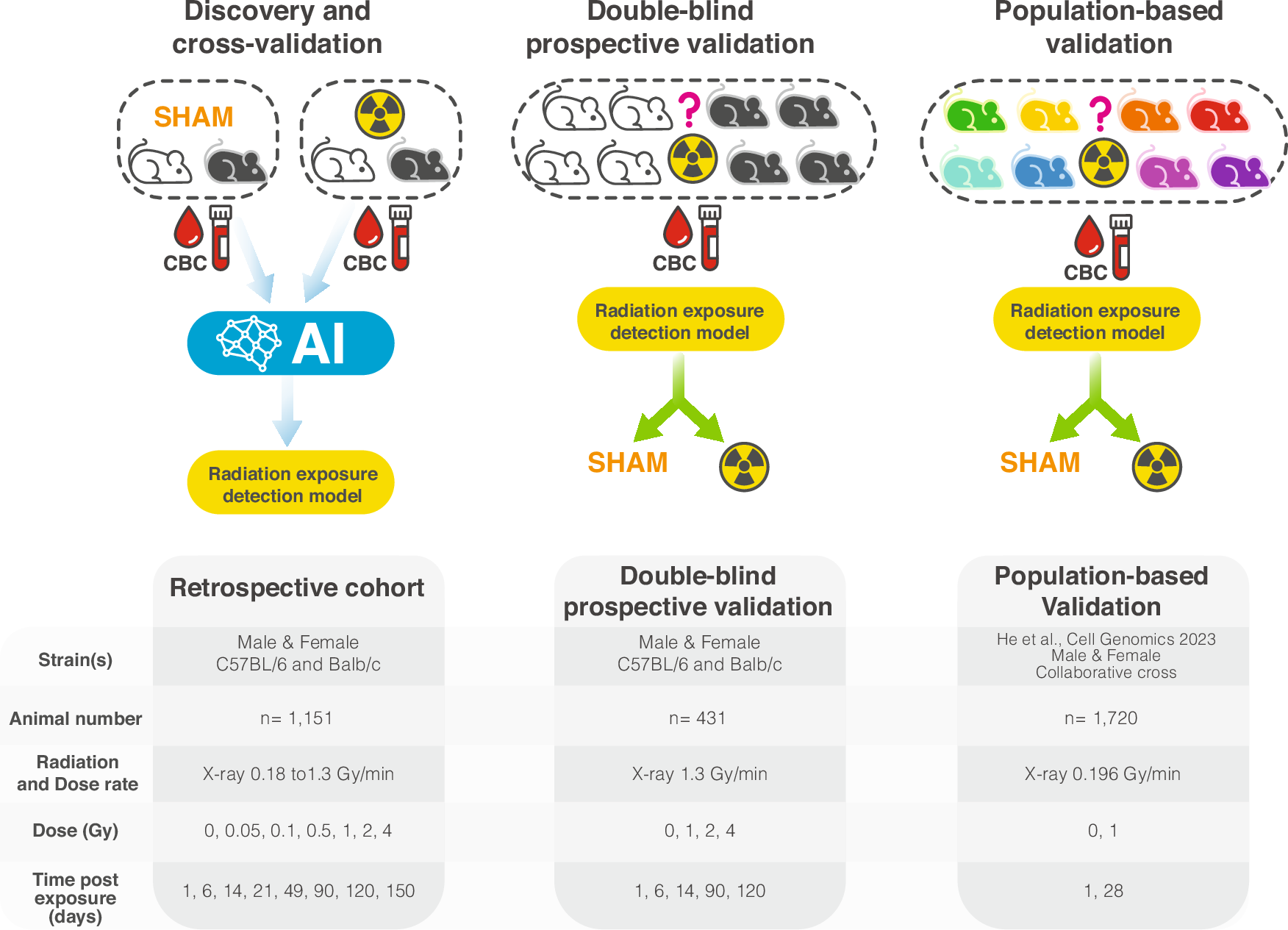
We analyze complete blood count (CBC) profiles from a retrospective cohort of 1151 male and female BALB/cJ and C57BL/6 J mice exposed to total-body X-ray radiation at doses ranging from 0.05 to 4 Gy. CBCs are collected 1 to 150 days post exposure. We develop a predictive model of radiation exposure using a sparse representation learning strategy to identify the most informative CBC parameters. Model performance is evaluated through exhaustive cross-validation and validated in a double-blind prospective cohort of 431 animals. To evaluate robustness in a genetically diverse population, we further test the model on CBC data from a Collaborative Cross (CC) cohort of 1720 animals representing 35 CC strains, 24 h and 28 days after sham or 1 Gy total-body X-ray exposure.
Results
Exhaustive cross-validation shows good performance of the Sparse CBC model, with AUC, accuracy and sensitivity exceeding 80%. Similar performance is observed in the prospective cohort. In the CC cohort, performance is modest. Importantly, model performance varies across CC strains, suggesting that host genetic background significantly influences predictive accuracy.
Conclusions
Our findings demonstrate that the Sparse CBC model effectively leverages CBC data to estimate radiation exposure across multiple mouse cohorts, including genetically diverse CC populations. While CBC-based predictions provide a complementary tool for exposure assessment, model performance varies with genetic backgrounds.