2026-08-03 スタンフォード大学
<関連情報>
- https://news.stanford.edu/stories/2026/08/new-pathway-found-make-luminescence
- https://pubs.acs.org/jacsat/article-abstract/doi/10.1021/jacs.6c07677/5238428/The-Force-Awakens-a-Dormant-Chemiluminescent
フォースが1,2-ジオキセタン中の休眠状態にある化学発光経路を覚醒させる The Force Awakens a Dormant Chemiluminescent Pathway in 1,2-Dioxetane
Garrett A. Kukier;Charles E. Diesendruck;Diptarka Hait;Rui Xu;Todd J. Martinez
Journal of the American Chemical Society Published:August 03, 2026
DOI:https://doi.org/10.1021/jacs.6c07677
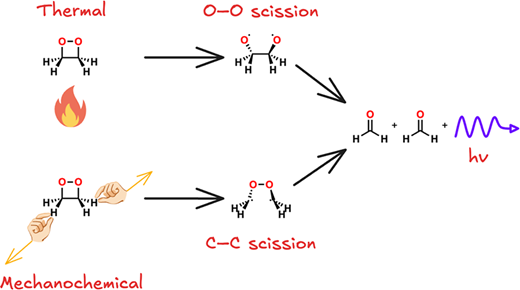
Abstract
1,2-Dioxetanes are well-known for their chemiluminescent decomposition initiated by O–O bond scission. Under thermal conditions, this chemiluminescence has been used for molecular imaging, while mechanochemical triggering of chemiluminescence can be a powerful tool for studying stress in materials. It has been widely assumed that mechanochemical activation follows the same O–O scission pathway as the thermal case. However, our first-principles simulations of the mechanochemically triggered decomposition of 1,2-dioxetane show that the traditional O–O scission pathway is largely insensitive to applied force. Instead, a thermally inaccessible C–C bond scission pathway is stabilized by applied force and becomes energetically favored above a critical force (∼1.8–3.0 nN). This force-induced mechanistic switch is robust across various pulling directions and substituents, including the experimentally tested adamantyl derivative. These findings establish a new, fundamentally force-dependent pathway for chemiluminescence. They demonstrate that mechanical force can be used not only to accelerate a reaction, but to fundamentally change its mechanism. This presents significant opportunities for new mechanophore design and mechanochemical sensing applications.