

2026-09-18 フランス国立科学研究センター(CNRS)
<関連情報>
- https://www.cnrs.fr/en/press/how-does-partially-molten-layer-form-above-marss-core
- https://www.nature.com/articles/s41561-026-02104-z
火星の核・マントル境界における長寿命マグマ層に関する実験的制約 Experimental constraints on a long-lived magma layer at the Martian core–mantle boundary
Rémy Pierru, Steeve Gréaux, Serena Dominijanni, Lianjie Man, Yoshio Kono, Sho Kakizawa, Yuji Higo, James Badro, Daniel J. Frost & Daniele Antonangeli
Nature Geoscience Published:18 September 2026
DOI:https://doi.org/10.1038/s41561-026-02104-z
Abstract
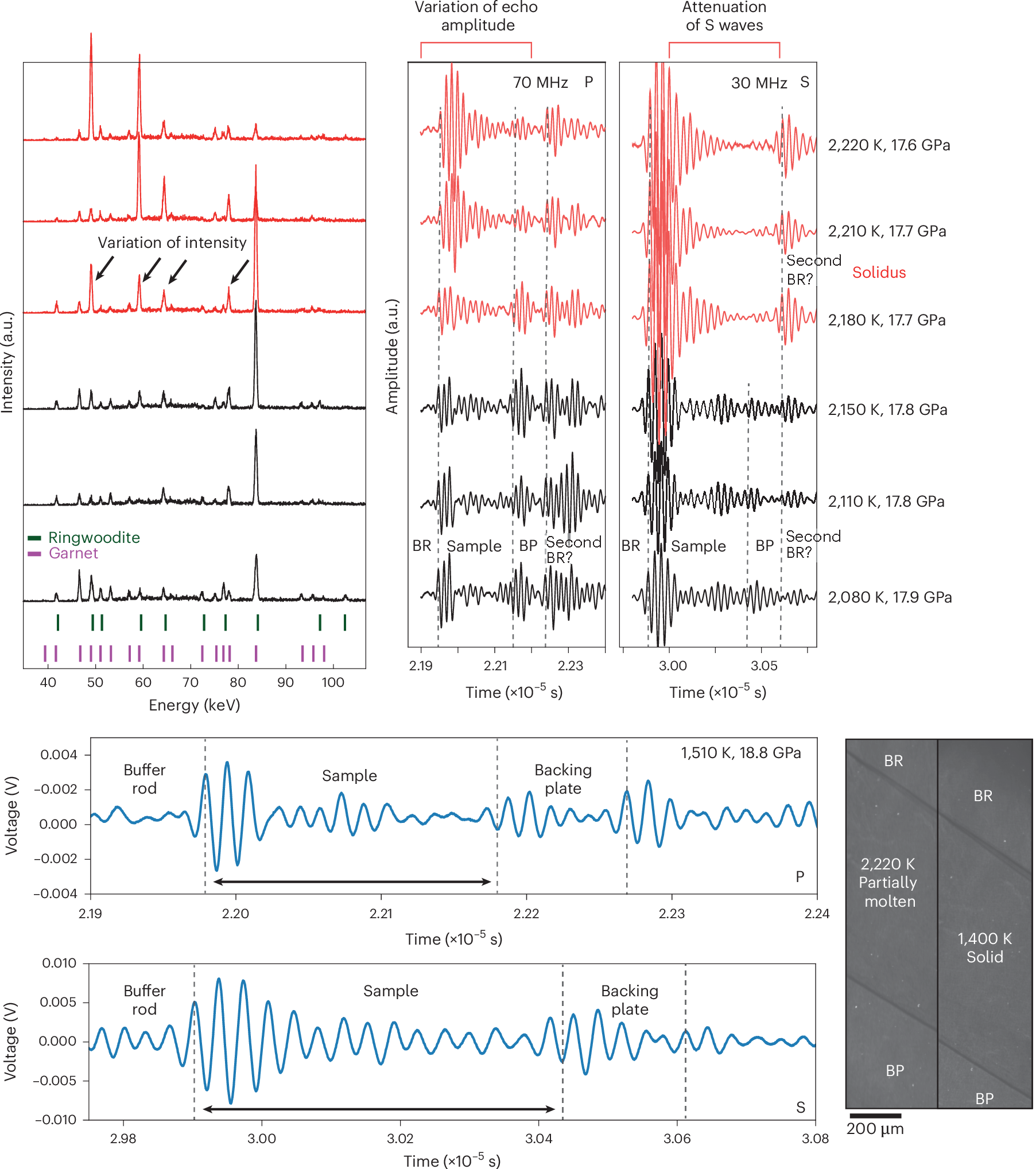
Geophysical observations from the InSight mission suggest anomalously low seismic velocities near the Martian core–mantle boundary, possibly indicating a molten silicate layer. Such a layer would have major implications for the thermal and chemical evolution of Mars, but its origin remains poorly constrained because experimental data on iron-rich Martian melts at deep-mantle conditions remain scarce. Here we use in situ ultrasonic interferometry combined with X-ray imaging and diffraction to determine the melting phase relations, ultrasonic response and chemical compositions of co-existing melts and solids under conditions relevant to the Martian core–mantle boundary. Our experiments constrain a Martian mantle solidus about 100 K lower than previous estimates. We show that incipient melting rapidly weakens the elastic response, reducing wave speeds and modifying the ultrasonic signal character. Melts generated slightly above the solidus at 18–19 GPa, equivalent to a depth of approximately 1,550 km, are strongly enriched in iron (Fe# of 0.5) and reach densities comparable to or greater than surrounding solids, implying neutral to negative buoyancy. The combination of high melt density and low wetting angles favours the formation of an interconnected dense melt layer near the core–mantle boundary from a moderately FeO-rich Martian mantle without necessarily requiring overturn of an extremely Fe-enriched primordial reservoir and remains compatible with proposed thermal models.

