
2026-04-29 中国科学院(CAS)
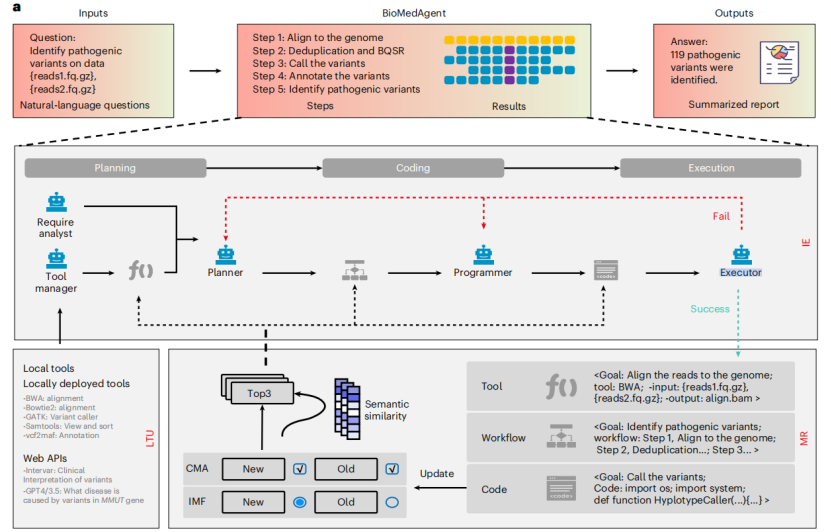
The “AI Data Scientist” computational framework BioMedAgent. (Image by ICT)
<関連情報>
- https://english.cas.cn/newsroom/research-news/202606/t20260624_1174789.shtml
- https://www.nature.com/articles/s41551-026-01634-6
マルチエージェントLLMフレームワークを用いてAIデータサイエンティストを支援し、自律的かつツール認識型の生物医学データ分析のための自己進化機能を実現する Empowering AI data scientists using a multi-agent LLM framework with self-evolving capabilities for autonomous, tool-aware biomedical data analyses
Dechao Bu,Jingbo Sun,Kun Li,Zihao He,Wei Huang,Jinlin Hu,Shanshan Zhang,Shuangshuang Lei,Peipei Huo,Zhihao Wang,Sheng Wang,Tao Wang,Kai Gao,Yang Wu,Lianhe Zhao,Kai Wang,Gen Li,Huan Song,Yang Jin,Kang Zhang,Runsheng Chen & Yi Zhao
Nature Biomedical Engineering Published:30 March 2026
DOI:https://doi.org/10.1038/s41551-026-01634-6
Abstract
Artificial intelligence agents are emerging as powerful applications of large language models (LLMs), automating complex tasks and enabling scientific data exploration. However, their use in biomedical data analysis remains limited by the difficulty of handling specialized tools and multistep reasoning. Here we introduce BioMedAgent, a self-evolving LLM multi-agent framework, which learns to use diverse bioinformatics tools and chain them into executable workflows through interactive exploration and memory retrieval algorithms. It allows biomedical users to initiate tasks using natural language, without requiring computational expertise. Evaluated on our newly released BioMed-AQA benchmark comprising 327 biomedical data tasks, BioMedAgent achieved a 77% success rate, surpassing other LLM agents, and generalized robustly to the external BixBench dataset. Beyond benchmarks, it autonomously performs cross-omics analysis, machine-learning modelling and pathology image segmentation, highlighting its potential to advance biomedical research and extend to other scientific domains requiring complex tool integration and multistep reasoning.

