2026-08-19 東北大学
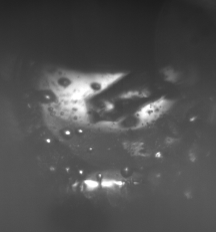
図1. 20 Kの液体水素中に設置した加熱面から発生する気泡の挙動を捉えた画像。
<関連情報>
- https://www.tohoku.ac.jp/japanese/2026/08/press20260819-05-bubble.html?utm_source=chatgpt.com
- https://www.sciencedirect.com/science/article/pii/S0735193326016817
液体水素プール沸騰における気泡挙動と熱伝達特性の可視化 Visualization of bubble behavior and heat transfer characteristics in liquid hydrogen pool boiling
Masaharu Kubota, Yuki Sakamoto, Junnosuke Okajima
International Communications in Heat and Mass Transfer Available online: 30 July 2026
DOI:https://doi.org/10.1016/j.icheatmasstransfer.2026.112160
Highlights
- High-speed imaging visualized liquid hydrogen pool boiling at 0.1–0.3 MPa.
- Hydrogen boiling curves and critical heat flux determined at 0.1–0.3 MPa.
- Rohsenow correlation empirical constant calibrated to 0.021 for hydrogen‑copper.
- Fluid and solid heat conduction govern bubble growth and departure frequency.
Abstract
Visualization and evaluation of the heat transfer characteristics of liquid hydrogen boiling are essential for establishing a hydrogen supply chain. In this study, pool boiling experiments were conducted under 0.1–0.3 MPa to investigate the effects of pressure on cryogenic boiling using high-speed visualization. The results indicated that pressurized conditions yielded higher values of the boiling heat transfer coefficient and critical heat flux in this pressure range. The measured boiling heat transfer coefficients were compared with existing correlations, suggesting that the Rohsenow correlation demonstrated good agreement with our findings. Specifically, the empirical coefficient of the Rohsenow correlation was determined to be 0.021 for the liquid hydrogen‑copper combination within the pressure range of 0.1–0.3 MPa. Furthermore, the boiling characteristics of liquid hydrogen were successfully visualized under steady-state nucleate and film boiling regimes. High-speed visualization of the isolated liquid hydrogen bubbles demonstrated that their growth is governed by heat conduction within both the fluid and solid. While vertical oscillations associated with capillary waves were observed, we hypothesize that, in the low buoyancy environment, minute bubbles accumulate and coalesce into a larger mass before undergoing macroscopic departure.