2026-08-20 岡山大学,京都大学,科学技術振興機構
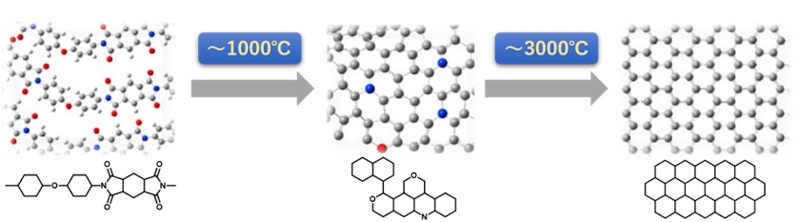
図1. ポリマーの炭素化の例
<関連情報>
- https://www.okayama-u.ac.jp/tp/release/release_id1585.html
- https://onlinelibrary.wiley.com/doi/10.1002/smll.75161
ピラー[5]アレーンの分岐炭化により、多孔質および層状炭素構造が生成される Divergent Carbonization of Pillar[5]Arenes Produces Porous and Lamellar Carbon Architectures
Tan-Hao Shi, Chenyi Ma, Kentaro Ohkura, Riki Kato, Tsubasa Hatanaka, Shoma Hori, Hiroo Suzuki, Shunsuke Ohtani, Kenichi Kato, Yuta Nishina, Tomoki Ogoshi
Small Published: 19 August 2026
DOI:https://doi.org/10.1002/smll.75161
ABSTRACT
Carbonization of organic precursors is widely used to produce carbon materials. However, the morphology and properties of the resulting carbons remain difficult to predict and control owing to complex pyrolytic reactions. Here, by using pillar[5]arenes as a structurally defined macrocyclic platform, we show that their peripheral functionality regulates carbonization in three distinct pathways, early-stage fixation, progressive coalescence, and melt-assisted reconstruction, providing microporous frameworks and fused lamellar carbons. Modulating the precursor aggregation further tunes the morphology at the micrometer scale. These pathway-defined architectures result in distinct functions, with microporous carbons favoring gas adsorption and lamellar carbons enabling electrical transport in exfoliated sheets. This work links the macrocyclic structure to the carbonization pathway and resulting properties, providing design guidance for converting molecular precursors into functional carbon materials.