2026-06-15 マックス・プランク研究所
<関連情報>
- https://www.mpg.de/26721358/amazon-rainforest-emits-new-stress-defense-molecules-during-el-nino-drought
- https://www.nature.com/articles/s43247-026-03597-7
強烈なエルニーニョ現象がアマゾン熱帯雨林におけるストレス防御として新たな反応性揮発性物質の生成を促す Intense El Niño provokes production of new reactive volatiles as stress defences in Amazon rainforest
Joseph Byron,Giovanni Pugliese,Carolina de A. Monteiro,Johanna Schuettler,Achim Edtbauer,Eliane Gomes Alves,S. Christoph Hartmann,Anywhere Tsokankunku,Denisi Holanda Hall,Cléo Q. Dias-Junior,Hartwig Harder,Jos Lelieveld & Jonathan Williams
Communications Earth & Environment Published:14 May 2026
DOI:https://doi.org/10.1038/s43247-026-03597-7
Abstract
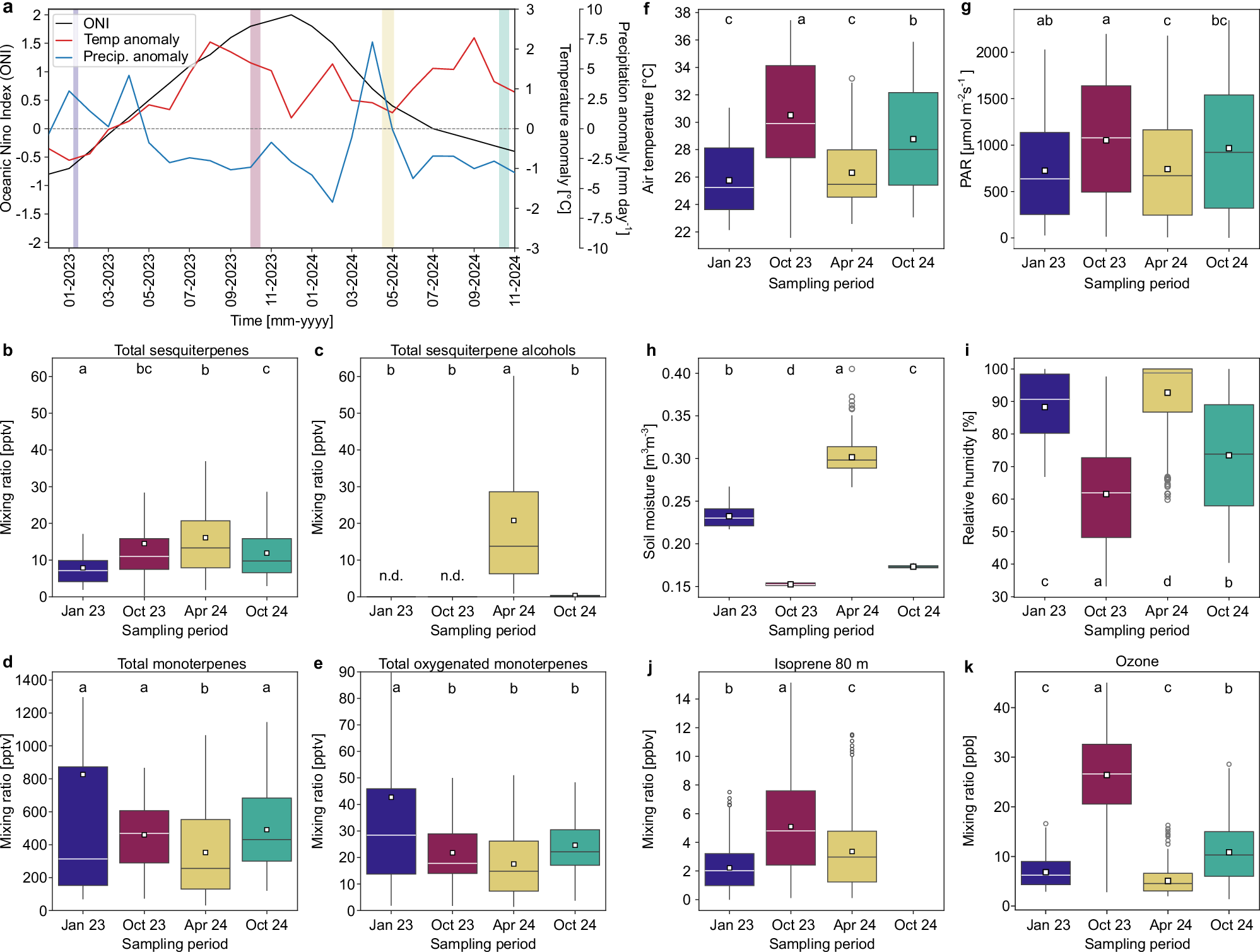
Climate change is increasing the frequency and severity of Amazonian droughts, and El Niño events are predicted to become more intense and persistent. Despite this, the effects of drought on biogenic volatile organic compound emissions from tropical rainforests remain poorly understood. Here we present speciated measurements of isoprene, monoterpenoids, and sesquiterpenoids from the Amazon rainforest spanning the 2023-2024 El Niño cycle, the most severe drought ever recorded in the Amazon basin. Monoterpenoid abundances showed little influence from El Niño, while sesquiterpenes increased by 122% across the El Niño duration. Unexpected emissions of lower-volatility sesquiterpene alcohols, including beta-eudesmol, alpha-eudesmol, and gamma-eudesmol, occurred during the wet season following the peak drought revealing an adaptation to adverse conditions linked to oxidative stress defence. Our results show how isoprenoid composition in the atmosphere shifts to lower-volatility, potentially more reactive compounds during severe drought, reflecting underlying metabolic changes as vegetation responds to abiotic stress.