

2026-06-08 マサチューセッツ大学アマースト校
◆従来の深層学習モデルは、新しい情報を学習すると過去の知識を失う「破滅的忘却(Catastrophic Forgetting)」や、大規模再学習に伴う高い計算コストが課題だった。研究チームは、生物の神経回路に見られる学習・記憶機構を模倣し、既存知識を保持しながら新たな情報を逐次学習できる仕組みを構築した。その結果、従来手法と同等以上の性能を維持しつつ、必要な計算資源とエネルギー消費を大幅に削減できることが確認された。
◆この技術は、エッジAIやロボット、自律システムなど、限られた電力環境で継続的に学習する次世代AIへの応用が期待される。研究は、より持続可能で省エネルギーなAI開発に向けた重要な一歩と位置付けられている。
 <関連情報>
- https://www.umass.edu/news/article/next-gen-ai-can-learn-continuously-while-consuming-fraction-computing-energy-required
- https://www.nature.com/articles/s41467-026-73830-6
チューリング ユニバーサル ニューラルネットワークはグローバルクロックを必要としない Turing universal neural networks do not require global clocks
Hava T. Siegelmann,Roy N. Siegelmann,Stephen Chung & Chloé Becquey
Nature Communications Published:05 June 2026
DOI:https://doi.org/10.1038/s41467-026-73830-6 Unedited version
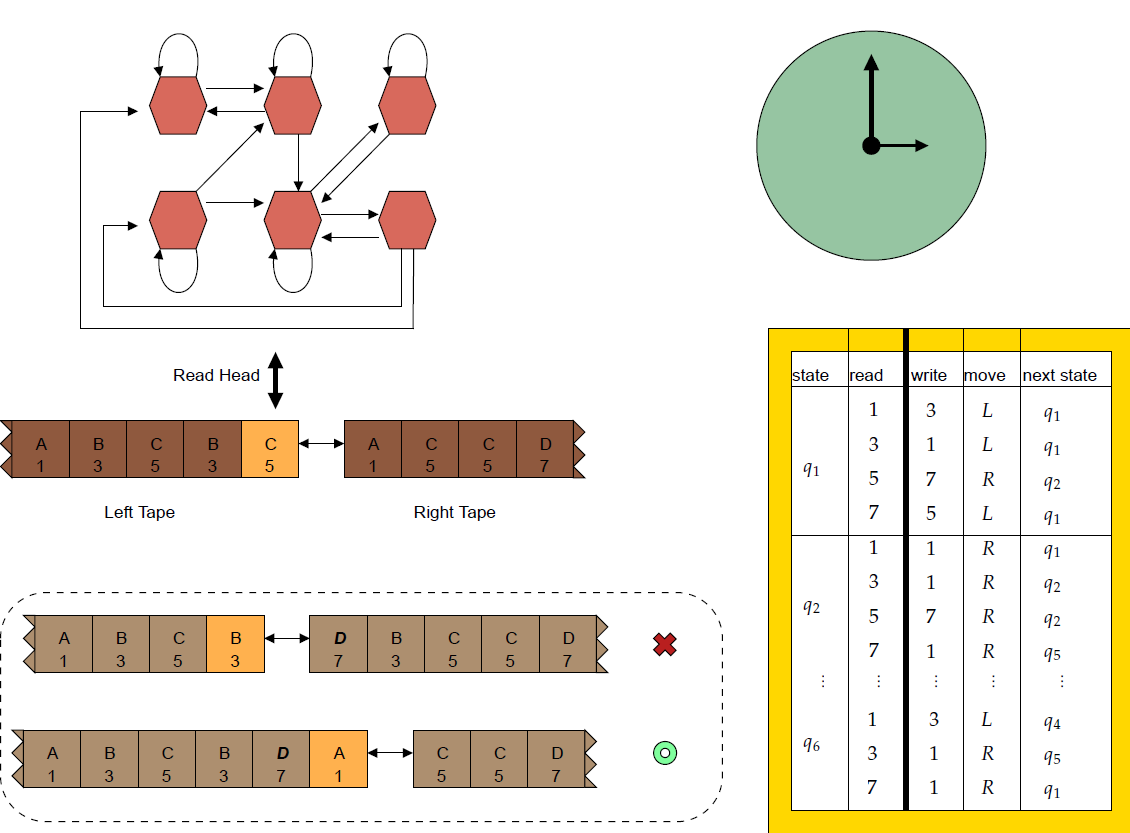
Figure 1: Turing Tape Simulation.
Abstract
Recurrent neural networks were proven to be Turing universal in the 1990s, motivating computational complexity studies of spiking networks, neural Turing machines with differentiable activations, and transformers. At the time, neural networks were exploratory and small, whereas today large-scale deployment makes energy efficiency critical. We thus extend the development of computational foundations of neural networks to asynchronous networks. Asynchrony is modeled by updating a single randomly selected neuron per step, eliminating global updates and reducing energy use. While asynchrony introduces variability in update sequences and thus has often been considered impractical for computing, we introduce design constraints which lead to Turing universal asynchronous architectures. We prove universality both for asynchronous fixed architectures with varying-precision neurons and for variable architectures with fixed-precision neurons. These results advance the theoretical understanding of asynchronous networks, suggesting that they preserve full computational power, remain amenable for efficient training, and may achieve substantial reductions in energy use.

