2026-06-16 北京大学(PKU)
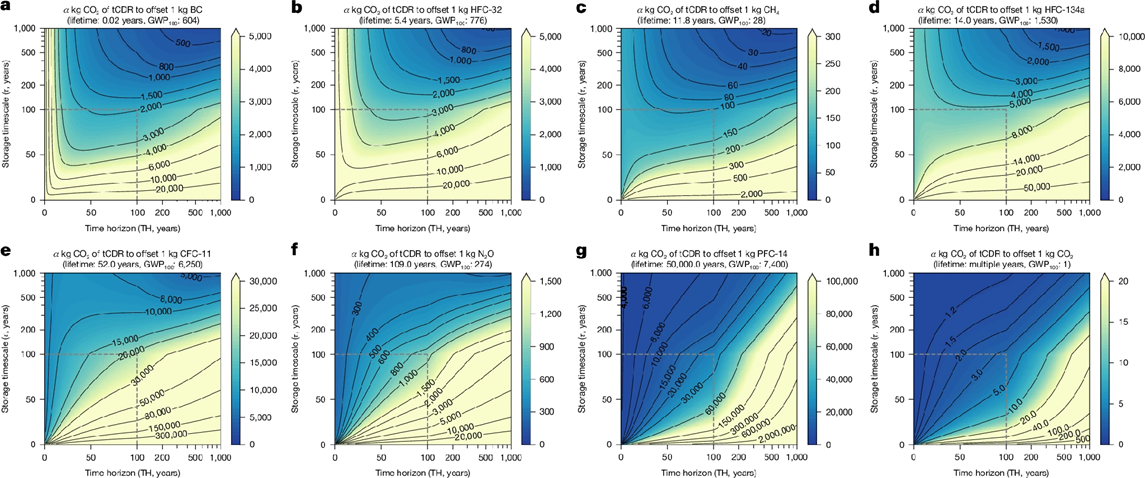
Figure 1. Amount of temporary carbon dioxide removal required to offset a unit pulse emission of different species across various storage timescales and time horizons.
<関連情報>
- https://newsen.pku.edu.cn/news_events/news/research/15583.html
- https://www.nature.com/articles/s41586-026-10607-3
短期的な気候変動要因を相殺するための二酸化炭素の一時的な除去 Temporary carbon dioxide removal to offset short-lived climate forcers
Yue He,Keywan Riahi,Matthew J. Gidden,Shilong Piao,Tao Wang & Thomas Gasser
Nature Published:27 May 2026
DOI:https://doi.org/10.1038/s41586-026-10607-3
Abstract
Carbon dioxide removal (CDR) is considered for achieving the long-term temperature objectives of the Paris Agreement and national net-zero emission targets1,2,3,4,5. The durability of these CDR methods varies widely, ranging from decades to theoretically permanent6. Temporary CDR dominates present deployment, whereas permanent solutions face further feasibility and cost challenges at scale1. However, efforts to integrate temporary CDR into climate policies have relied on equivalency assumptions between temporary and permanent CDR that contradict physical climate science: temporary CDR cannot fully offset CO2 emissions as permanent CDR can6,7. Here we show that temporary CDR can serve as compensation for non-CO2 climate forcers, particularly for short-lived species whose compensation ratios are fairly insensitive to the choice of time horizon. For instance, offsetting 1 kg CH4 requires 498 kg CO2 with 20-year temporary storage (such as bioplastics) or 101 kg CO2 with 100-year storage (such as durable wood products). We suggest a critical lifetime threshold separating short-lived and long-lived species for temporary CDR applications, with implementation requiring differentiated reporting of these categories. This framework can provide a physical basis for crediting temporary CDR activities in sectors such as agriculture, in which non-CO2 emissions dominate and direct emission reductions remain challenging.