2026-05-29 中国科学院(CAS)
<関連情報>
- https://english.cas.cn/newsroom/research-news/202605/t20260529_1160177.shtml
- https://acp.copernicus.org/articles/26/4823/2026/
スチレンの多世代● OH酸化による多官能性生成物の生成機構に関する研究 Mechanistic investigations of the formation of multifunctional products from the multi-generation ●OH oxidation of styrene
Long Chen, Yu Huang, Yonggang Xue, Long Cui, and Zhihui Jia
Atmospheric Chemistry and Physics Published:13 Apr 2026
DOI:https://doi.org/10.5194/acp-26-4823-2026
Abstract
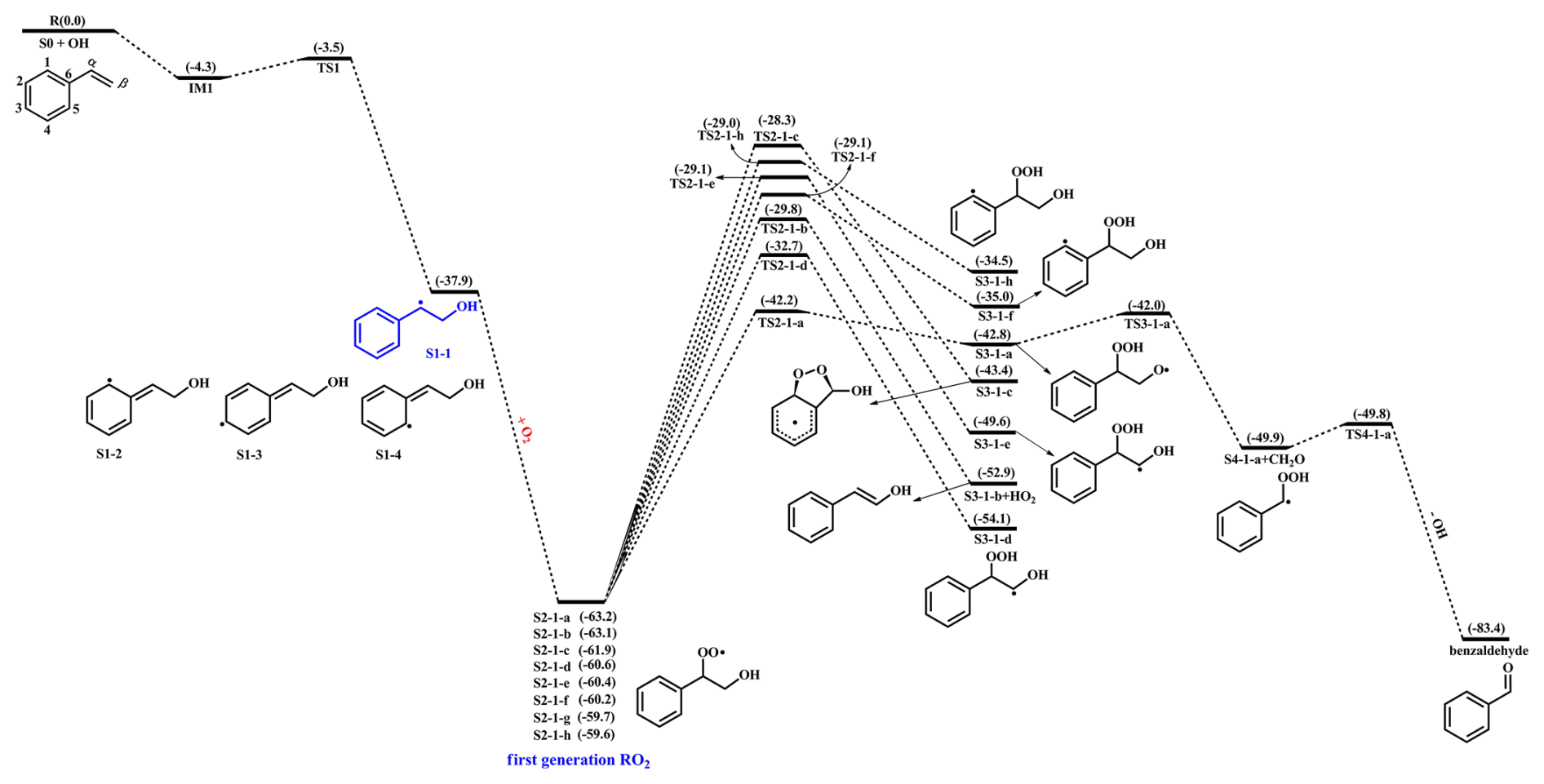
Styrene is a highly reactive aromatic hydrocarbon that has been identified as a key secondary organic aerosol (SOA) precursor. Recent laboratory chamber experiments have identified C7 and C8 series compounds as the main components of SOA in the photooxidation of styrene. However, their molecular structures and formation pathways remain largely uncharacterized. Herein, the formation mechanisms of multifunctional products from the multi-generation •OH oxidation of styrene are studied using the quantum chemistry methods. The calculations show that the first generation RO2 radicals can either proceed unimolecular decomposition to yield benzaldehyde (C7H6O), or undergo bimolecular reactions with HO2•/NO to form the first generation closed-shell C7– and C8-products, hydroperoxide 1st-ROOH (C8H10O3), benzaldehyde, and organic nitrate 1st-RONO2 (C8H9NO3). For the second generation •OH oxidation, OH-addition reaction occurring at the ortho-site of 1st-ROOH and 1st-RONO2 has a significant dominance. The ortho-OH-addition products can proceed through two O2-addition steps and a cyclization process to produce the peroxide bicyclic peroxy radicals (BPR). BPR can further react with HO2•/NO to form the second generation closed-shell C8-products, hydroperoxide 2nd-ROOH (C8H12O8), organic nitrate 2nd-RONO2 (C8H10N2O10), and other multifunctional products, in which the first two products have fractional yields of 41.4 % and 4.8 %, respectively. For the third generation •OH oxidation, OH-addition occurring at the C=C double bond of 2nd-ROOH and 2nd-RONO2 has the lowest barrier. The major third generation closed-shell C8-products are the multifunctional hydroperoxides and organic nitrates. These findings carry important implications for advancing our understanding of the chemical composition and formation mechanisms of aromatic SOA.