2026-05-29 中国科学院(CAS)
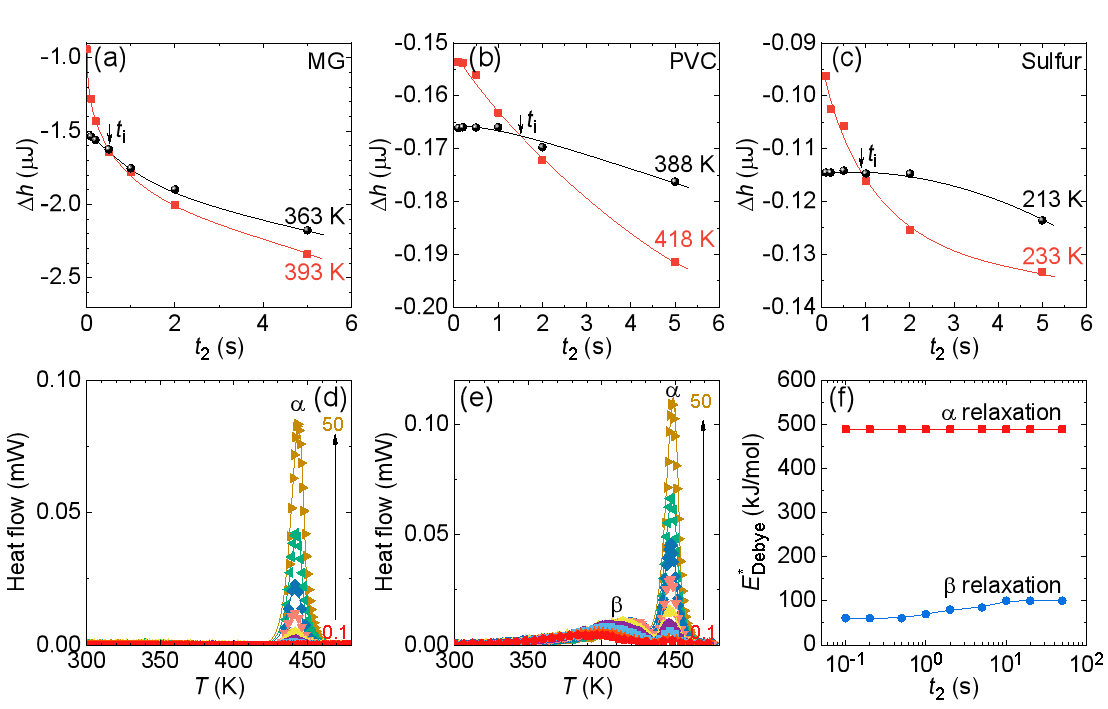
The enthalpy relaxation processes of glasses (Image by NIMTE)
<関連情報>
- https://english.cas.cn/newsroom/research-news/202605/t20260529_1160178.shtml
- https://journals.aps.org/prl/abstract/10.1103/znc5-brc6
ガラスの異常な老化速度論リラクゼーション Pealike Abnormal Aging Kinetics of Glasses Derived from Relaxation
Lijian Song, Meng Gao, Wei Xu, Juntao Huo, and Jun-Qiang Wang
Physical Review Letters Published: 19 May, 2026
DOI: https://doi.org/10.1103/znc5-brc6
Abstract
It has been a long, interesting, and mysterious nonequilibrium phenomenon that hot water may freeze faster than warm water, which is known as Mpemba effect. Studying its physical origin and exploring new Mpembalike effects have attracted broad interests. Here, we report experimental evidence of a novel Mpembalike effect in the aging process of glasses: a glass with an initial higher energy state ages (enthalpy decreases) faster and surpasses the glass with an initial lower energy state. This phenomenon is universally observed in different types of structural glasses, including metallic, polymer, and molecular glasses. The underlying thermodynamic mechanism is also studied using high-precision nanocalorimetry. It is found that preannealing at a higher temperature is critical to triggering the faster aging kinetics of the Mpembalike effect. This is attributed to the activation of a secondary β relaxation peak with a substantially lower kinetic barrier than the primary α relaxation peak. Thus, besides the α relaxation, the β relaxation plays a pivotal role in the enthalpy aging process, which is very sensitive to the thermal history. These findings may have broad implications for optimizing the thermal treatment and relaxations of different types of glasses.