
20026-07-07 カリフォルニア大学サンディエゴ校(UCSD)
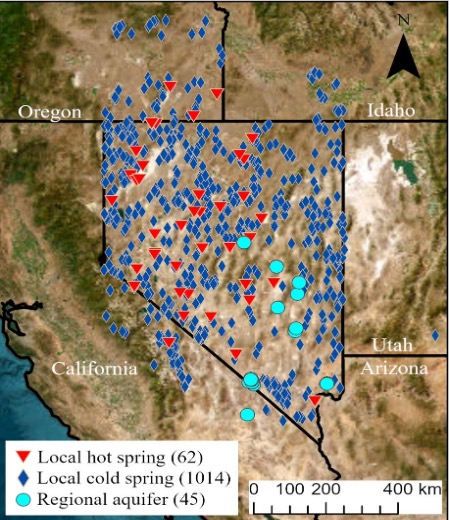
Map of all 1,121 springs from the Great Basin and Mojave Desert regions analyzed in the study
<関連情報>
- https://today.ucsd.edu/story/study-biodiversity-hotspots-in-american-west-face-extinction
- https://aslopubs.onlinelibrary.wiley.com/doi/10.1002/lno.70414
固有種のオアシス:地域の帯水層砂漠の湧水は、グレートベースンとモハベ砂漠地域における生物多様性のホットスポットとして機能し、絶滅危惧種の固有種を保護している Oases of endemism: Regional aquifer desert springs serve as biodiversity hotspots preserving vulnerable endemic taxa in the Great Basin and Mojave Desert regions
Matthew J. Forrest, Donald W. Sada, Matthew S. Edwards, Robert K. Burton, Richard D. Norris
Limnology and Oceanography Published: 03 June 2026
DOI:https://doi.org/10.1002/lno.70414
Abstract
Spring ecosystems in arid regions often serve as crucial biodiversity hotspots by providing some of the only reliable sources of surface water. However, anthropogenic activities and climate change have severely degraded spring ecosystems worldwide, emphasizing the need for large-scale multidisciplinary studies informing conservation efforts. Here, we analyzed characteristics of 1121 widely dispersed springs within the Great Basin and Mojave Desert regions, USA to assess the distribution of endemic animal taxa relative to hydrological, geochemical, and ecological parameters. To our knowledge this is the largest original dataset of springs that has been examined in this manner. Our results revealed that the three broad classes of springs: regional aquifer thermal springs, local aquifer cold springs, and local aquifer geothermal springs can be distinguished by their environmental and physicochemical parameters, taxa present, persistence, and natural and human perturbations. Notably, regional aquifer thermal springs support disproportionate numbers of endemic taxa, likely reflecting their stability and longevity. These patterns are particularly striking considering that these springs have been subjected to extreme anthropogenic exploitation and modifications for centuries and frequently support non-native taxa. Conversely, local aquifer cold springs, which are often highly disturbed and less persistent, support proportionately fewer endemic taxa. The high abundance of endemic taxa in regional aquifer thermal springs indicates that they represent critical biodiversity hotspots, and efforts to conserve and restore these important ecosystems should be major priorities.

