2026-05-12 電気通信大学
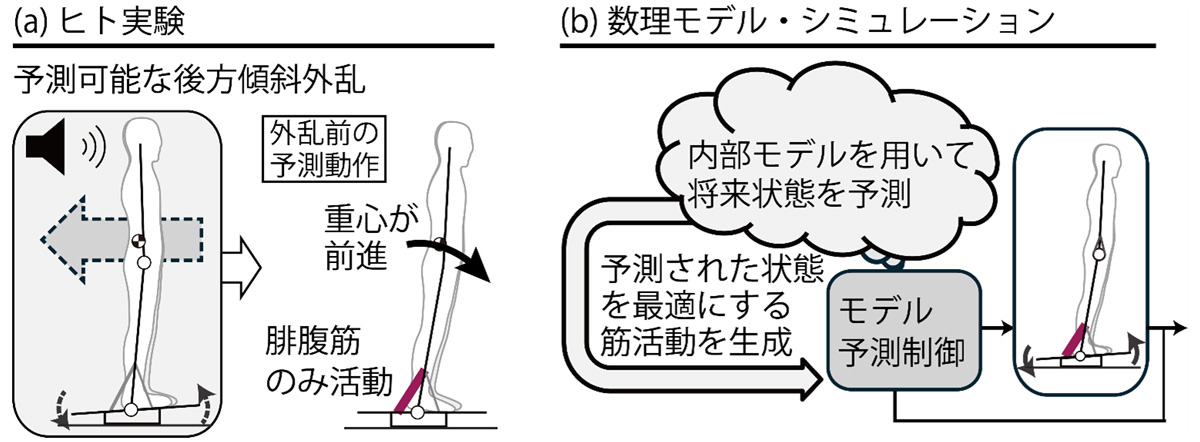
図1:研究概要図。(a) ヒト実験の概要。直立中の被験者に合図後、床傾斜外乱を与えると、外乱前に重心の前進と腓腹筋活動が見られた。(b) 数理モデル・シミュレーションの概要。筋骨格モデルとモデル予測制御を組み合わせた力学シミュレーションにより、ヒトで観察された予測期間の重心前進と腓腹筋活動が再現された。
<関連情報>
- https://www.uec.ac.jp/news/newsrelease/2026/20260512_7643.html
- https://www.nature.com/articles/s42003-026-10016-2
予測的な姿勢制御は、運動準備のための予測的かつ最適化された戦略から生じる Anticipatory postural control emerges from a predictive and optimized strategy for movement preparation
Tetsuro Funato,Miho Ogawa,Akira Konosu & Dai Yanagihara
Communications Biology Published:06 April 2026
DOI:https://doi.org/10.1038/s42003-026-10016-2
Abstract
Humans shift their center of mass (COM) forward before predictable backward floor tilts. This anticipatory movement is accompanied by selective activation of the gastrocnemius muscle (GC), which produces backward torque at the ankle even as the body moves forward. The control mechanism underlying this coordination between forward COM motion and GC activation remains unclear. Here we investigate whether such behavior can be explained within a predictive optimal control framework. In experiments with auditory cues, anticipatory COM shift and GC activation were observed, representing a use of a backward-acting muscle during forward movement. We then developed a musculoskeletal simulation model governed by model predictive control (MPC), which reproduced these patterns. The simulation suggests the body shifts forward by leveraging gravity, while GC activation stabilizes the ankle and prevents collapse. These findings indicate that anticipatory postural responses may result from optimizing predicted future states using internal models that incorporate gravitational dynamics for efficient motor preparation.