2026-04-23 中国科学院(CAS)
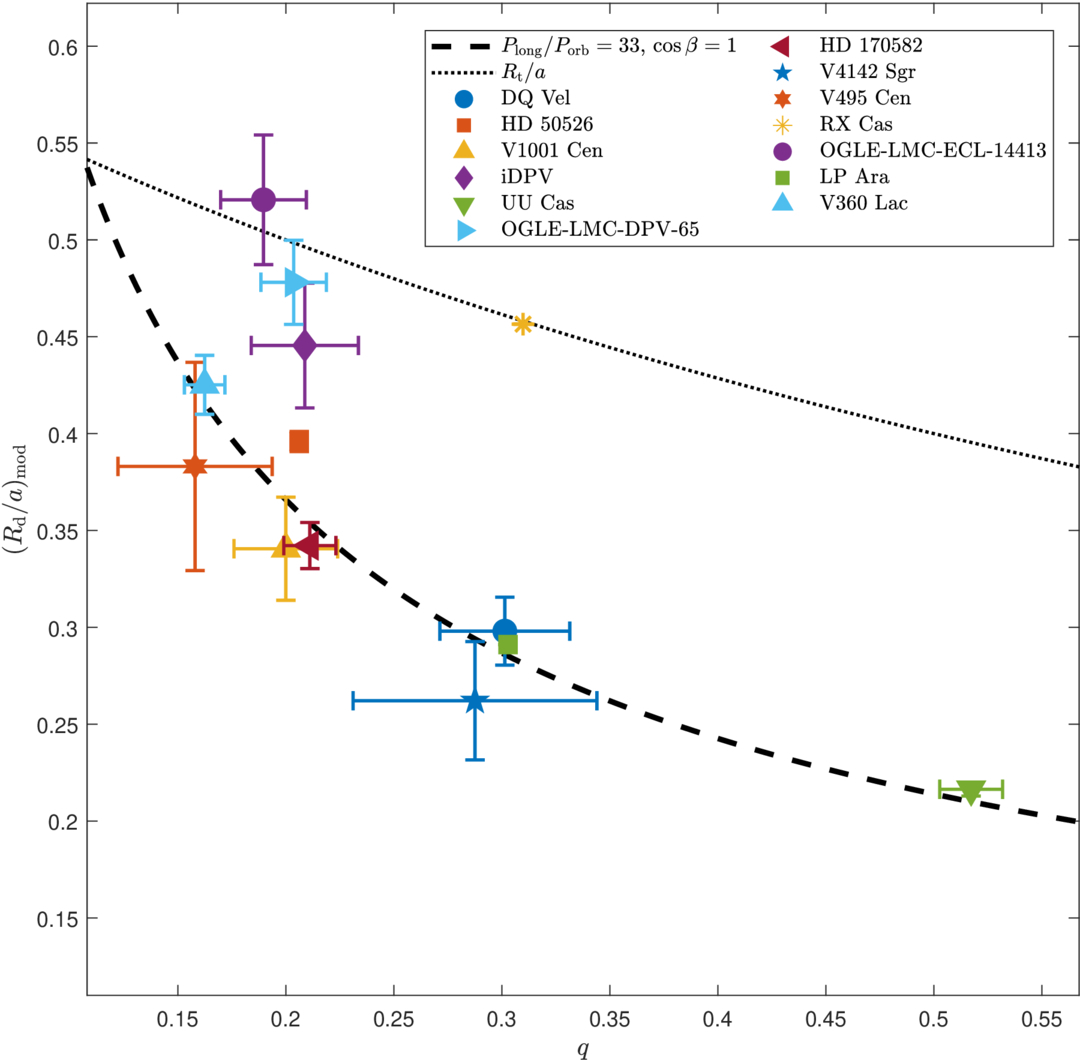
Model-predicted disk radius as a function of mass ratio q for 13 DPV systems. (Image by JIAO Chengliang)
<関連情報>
- https://english.cas.cn/newsroom/research-news/202605/t20260508_1158617.shtml
- https://iopscience.iop.org/article/10.3847/1538-4357/ae4b30
傾斜した降着円盤の節点歳差運動による二重周期変光星の長い測光サイクル Long Photometric Cycles in Double-periodic Variables from Nodal Precession of a Tilted Accretion Disk
Cheng-Liang Jiao (焦承亮), Er-gang Zhao, Liying Zhu, and Azizbek Matekov
The Astrophysical Journal Published: 2026 March 18
DOI:10.3847/1538-4357/ae4b30
Abstract
We investigate whether the long photometric cycles observed in double-periodic variables (DPVs) can arise from nodal precession of a tilted accretion disk driven by the tidal torque of the companion. Within a simple analytical framework, we derive testable relations linking the long-to-orbital period ratio to the binary mass ratio, the normalized disk size, and the disk tilt angle β, which itself can be inferred from the long-cycle amplitude, orbital inclination i, and disk luminosity fraction. The model naturally reproduces the two observed long-cycle light-curve morphologies—sinusoidal and double hump—distinguished by the geometric criterion i + β ≤ 90° versus i + β > 90°. Applying these relations to a sample of DPVs, we find that the inferred disk sizes are physically reasonable and consistent with independent light-curve modeling for a nonnegligible subset of systems. Our results show that tidal nodal precession represents a viable and potentially important contributor to the long-period variability of DPVs and provide a quantitative framework for future observational and theoretical studies.