2026-03-03 東京科学大学
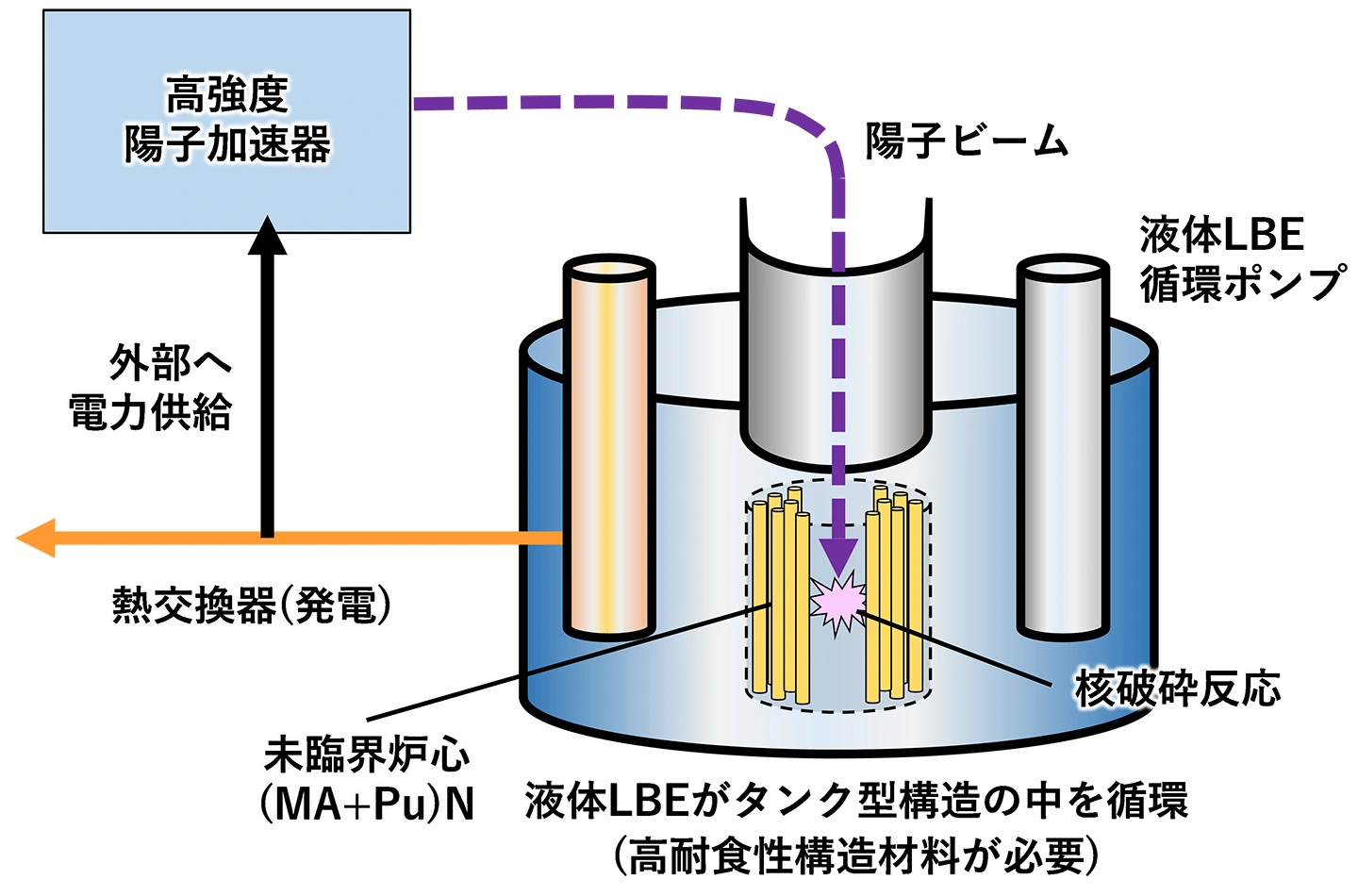
図1.液体LBEターゲット式の加速器駆動型未臨界炉(ADS)の概要
<関連情報>
- https://www.isct.ac.jp/ja/news/p2w4t89flyh5
- https://www.sciencedirect.com/science/article/abs/pii/S0010938X26000557?via%3Dihub
流動鉛ビスマス共晶溶液中で4000時間曝露したFeCrAl合金の人工研磨表面における保護酸化物層の再形成 Reformation of protective oxide layers on artificially abraded surfaces of FeCrAl alloy during 4000 h exposure in flowing lead-bismuth eutectic
Masatoshi KONDO, Yoshiki KITAMURA, Atsushi KAWARAI, Shigeru SAITO, Hironari OBAYASHI
Corrosion Science Available online: 21 January 2026
DOI:https://doi.org/10.1016/j.corsci.2026.113646
Highlights
- Corrosion behavior of FeCrAl alloy was studied in flowing LBE at 723 K for 4000 h.
- Multiple Fe-, Cr-, and Al-rich oxide sub-layers formed in situ and suppressed corrosion.
- Multiple oxide layers re-formed in situ in flowing LBE after removal by abrasion.
- In-situ formed oxide layers exhibited high shear adhesion strength in shear direction.
- Pre-formed α-Al₂O₃ layer remained adherent after 2000 h exposure to flowing LBE.
Abstract
The corrosion resistance of FeCrAl alloy APMT (Fe-21Cr-5Al-3Mo) in flowing lead-bismuth eutectic (LBE) was investigated by corrosion tests performed at 723 K using a non-isothermal forced convection loop. The oxygen concentration in flowing LBE was controlled at 1 × 10⁻⁶ wt%. No severe corrosion or erosion was detected on the specimens exposed to flowing LBE for 2000 h and 4000 h. Multiple oxide layers consisting of Fe-rich, Cr-rich and Al-rich sub-layers were formed in situ on the surface of APMT during the corrosion tests, which effectively suppressed corrosion and erosion. The oxide layers were intentionally removed by gentle abrasion prior to re-immersion and the specimens were then re-immersed in flowing LBE for an additional 2000 h. The oxide layers were spontaneously re-formed in situ on the abraded surface. This behavior indicates a self-healing capability. The results of micro-scratch tests indicated that the in-situ formed multiple oxide layers exhibited high adhesion strength in the shear direction after the 2000 h corrosion test. The α-Al2O3 layer pre-formed by oxidation in air at 1373 K remained adherent to the APMT specimen during exposure to flowing LBE for 2000 h. The adhesion strength of the α-Al2O3 layer in the shear direction was not degraded after the corrosion test.