2026-03-03 東京理科大学
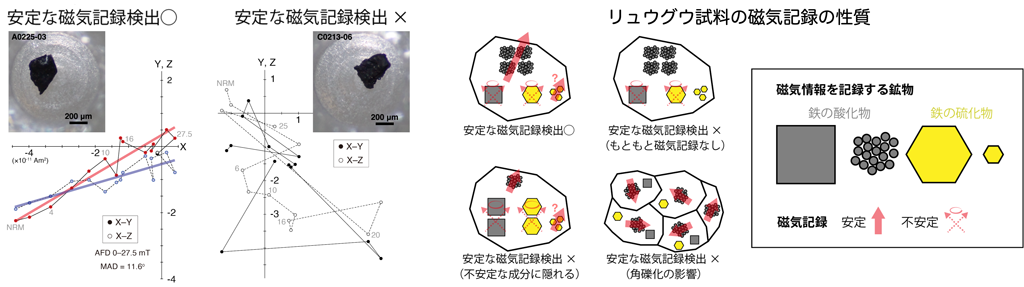
図 リュウグウ試料の磁気記録データ(左)と磁気記録の性質(右)
<関連情報>
- https://www.tus.ac.jp/today/archive/20260227_0127.html
- https://agupubs.onlinelibrary.wiley.com/doi/10.1029/2025JE009265
小惑星リュウグウから帰還した微粒子中の自然残留磁気記録の特徴 Characteristics of Natural Remanence Records in Fine-Grained Particles Returned From Asteroid Ryugu
Masahiko Sato, Yuki Kimura, Tadahiro Hatakeyama, Tomoki Nakamura, Satoshi Okuzumi, Sei-ichiro Watanabe, Seiji Sugita, Satoshi Tanaka, Shogo Tachibana, Hisayoshi Yurimoto, …
Journal of Geophysical Research: Planets Published: 10 February 2026
DOI:https://doi.org/10.1029/2025JE009265
Abstract
Particles collected from the asteroid Ryugu by the Hayabusa2 spacecraft offer a unique opportunity to investigate the magnetic record of the primitive solar system, as any terrestrial magnetic contamination is minimal and can be accounted for. In previous studies, stepwise alternating field demagnetization (AFD) measurements of natural remanent magnetization (NRM) records have been conducted on seven Ryugu particles. However, due to the limited number of samples, there is no consensus regarding the interpretation of the results of these measurements. To address this problem, we performed stepwise AFD measurements of the NRM on 28 Ryugu particles. Twenty-three of the particles exhibited one or two stable NRM components, whereas the remaining five did not. Isothermal remanent magnetization-based paleointensity values derived from stable NRM components varied by more than one order of magnitude. These NRM characteristics were consistent with those observed in previous studies. Therefore, as a reflection of the original nature of the NRM record, some Ryugu particles exhibited stable NRM components, whereas others did not. The Ryugu particles investigated in this study and those from a previous study exhibited spatially inhomogeneous NRM directions within individual particles, constraining the NRM acquisition time to before the final solidification of the current Ryugu particles. A mechanism of remanence acquisition that can explain the observed NRM characteristics is a chemical remanent magnetization associated with the growth of framboidal magnetite during aqueous alteration in Ryugu’s parent body.
Plain Language Summary
This study used tiny rock particles collected from the asteroid Ryugu by the Hayabusa2 spacecraft to study the magnetic field records of the early solar system. These particles have not been affected by the Earth’s environment, making them ideal for this kind of research. This study measured the natural remanent magnetization in 28 particles. Most particles (23 out of 28) held stable magnetic signals, while a few did not. The stable signals varied in strength. Some particles even showed multiple magnetic directions, suggesting that the signals were formed before the final solidification of the current Ryugu particles. These magnetic signatures likely came from a process involving water and the growth of tiny magnetic minerals inside Ryugu’s parent body. This means that the particles preserved a record of the magnetic field that existed very early in the history of the solar system, possibly just a few million years after it began forming.
Key Points
- Stable natural remanent magnetization (NRM) components were identified in 23 out of 28 Ryugu particles, with paleointensity values ranging from 16.3 to 174 μT
- Spatially inhomogeneous NRM directions within single particles suggest that remanence was acquired before particle solidification
- NRM characteristics are explained by chemical remanent magnetization carried by framboidal magnetite formed during aqueous alteration in Ryugu’s parent body