2026-01-30 中国科学院(CAS)
<関連情報>
- https://english.cas.cn/newsroom/cas-in-media/202601/t20260130_1148092.shtml
- https://www.nature.com/articles/s41586-025-10034-w
分散型都市間量子センサーによるアクシオン暗黒物質への制約 Constraints on axion dark matter by distributed intercity quantum sensors
Yuanhong Wang,Ying Huang,Xiang Kang,Dangui Chang,Jiaxuan Xu,Yifan Chen,Szymon Pustelny,Wenqiang Zheng,Min Jiang,Xinhua Peng & Jiangfeng Du
Nature Published:28 January 2026
DOI:https://doi.org/10.1038/s41586-025-10034-w
Abstract
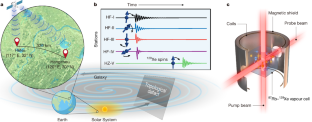
Ultralight axion particles are candidates for dark matter1, conjectured to form stable, macroscopic field configurations in three-dimensional space, resulting in the possible formation of topological defect dark matter2,3,4 (TDM). Exploring their possible existence through a realistic parameter space requires considering interactions that extend beyond the constraints imposed by astrophysical observations of stellar cooling processes5. Here we report the outcome of an experiment that monitors possible transient rotations of polarized spins, which could be induced by the interaction with topological defects, carried out by correlating five noble-gas laboratory set-ups located in two cities. Amplification and optimal noise filtering in hyperpolarized noble-gas spins greatly enhance the sensitivity to TDM-induced spin rotations, reaching approximately 10−6 rad. Through this, we set constraints on the axion–nucleon coupling across an axion mass range from 10 peV to 0.2 μeV, achieving 4.1 × 10¹⁰ GeV at 84 peV. These values exceed known constraints imposed by astrophysical observations, although these are obtained under different model assumptions. Our approach could further stimulate broad beyond-Standard Model physics searches, such as transient axion waves, axion stars, axion strings and Q-balls.