2026-10-29 中国科学院(CAS)
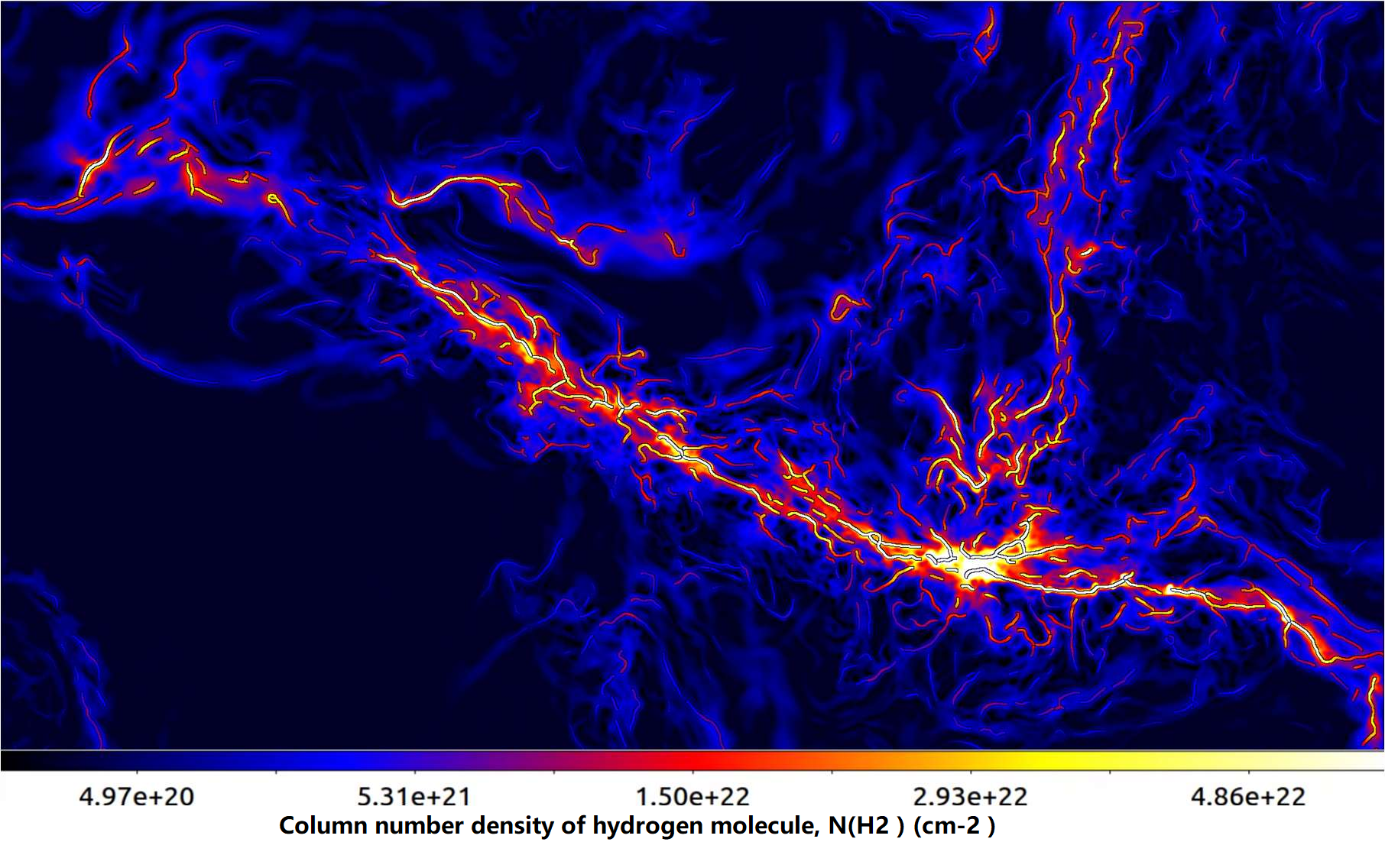
Column density map of a 4.4 pc-long filamentary cloud composed of many filamentary substructures from the simulation. The mean magnetic field is perpendicular to the image. (Image by LI Pak-Shing)
<関連情報>
- https://english.cas.cn/newsroom/research-news/202610/t20261029_1212780.shtml
- https://iopscience.iop.org/article/10.3847/1538-4357/aea6cb
磁化された星間分子雲 III. フィラメントの衝突とコアの形成:サブ構造と進化に関する考察 Magnetized Interstellar Molecular Clouds. III. Filament Collisions and Core Formation: Insights into Substructures and Evolution
Pak Shing Li, Christopher F. McKee, and Richard I. Klein
The Astrophysical Journal Published: 2026 October 21
DOI:10.3847/1538-4357/aea6cb
Abstract
We present the results of a driven, ideal magnetohydrodynamics simulation of a molecular cloud to study the formation of filamentary structures in molecular clouds and their fragmentation into dense cloud cores. Shock compression results in the formation of subparsec-long filamentary structures. Large-scale supersonic flows push these small filaments together and form massive filamentary clouds. The main filament that forms stretches across the full 4.4 pc length of the simulation and has a median FWHM of 0.075 pc, similar to that observed in many molecular clouds. Subfilaments inside the main filament have a median FWHM of 0.03–0.04 pc, similar to the “fibers” observed in molecular lines. The collision and merger of subcritical subfilaments is an important mechanism for the formation of prestellar cores. Colliding subfilaments and the resulting core at their intersection form a hub–filament system similar to that associated with massive star formation, but on a smaller scale. Core mergers can be significant in the growth of prestellar cores and may play a role in the formation of binary stars.