2026-10-26 マサチューセッツ工科大学(MIT)
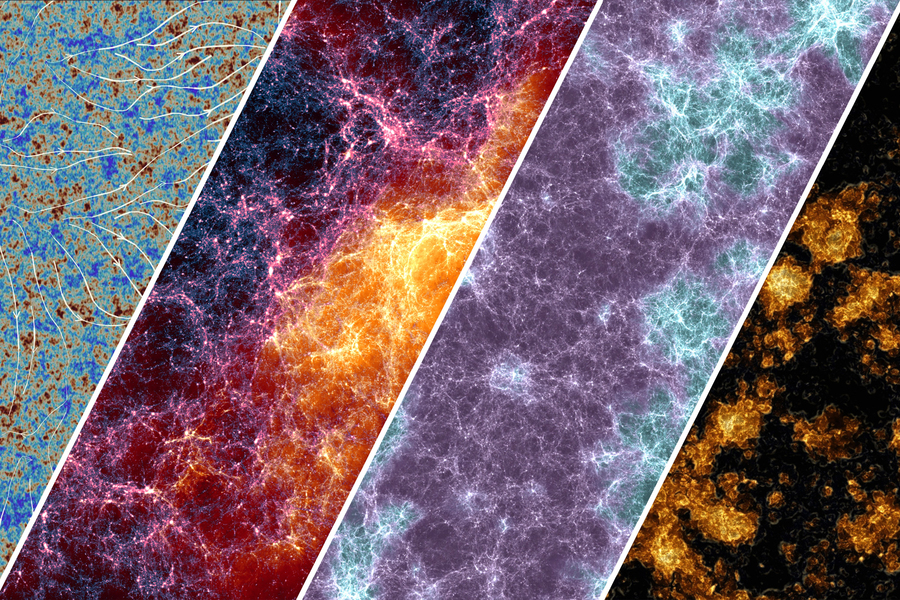
A composite image of Lumina’s scales of simulation, depicting (from left to right) the streaming velocities of subatomic particles and dark matter in the beginning of simulation; gas structures during helium reionization, color-coded by how fast the gas is moving; helium reionization where blue indicates regions that are ionized by supermassive black holes; and hydrogen reionization, where bright regions show bubbles where radiation from galaxies has ionized hydrogen, while the dark regions are still neutral.Credit: Lumina collaboration
<関連情報>
- https://news.mit.edu/2026/watch-universe-emerge-from-dark-ages-with-lumina-1026
- https://academic.oup.com/mnras/article/552/4/stag1469/8971942
ルミナプロジェクト の紹介:水素とヘリウムの再電離時代の大規模放射流体力学シミュレーション Introducing the lumina project: large-volume radiation-hydrodynamic simulations of the epochs of hydrogen and helium reionization
Oliver Zier , Aaron Smith , Xuejian Shen , Rongrong Liu , Rahul Kannan , Sonja M Koehler , Volker Springel , Rüdiger Pakmor , Mark Vogelsberger , Teodora-Elena Bulichi, …
Monthly Notices of the Royal Astronomical Society Published: 26 October 2026
DOI:https://doi.org/10.1093/mnras/stag1469
Abstract
Understanding how galaxies and active galactic nuclei (AGNs) jointly drive the reionization of the intergalactic medium (IGM) across cosmic time remains a major challenge in cosmology. We present Lumina, a large-volume radiation-hydrodynamic simulation that self-consistently follows the coupled evolution of the IGM, galaxies, and AGNs through HⅠ,HeⅠ , HeⅡ and reionization down to redshift z=3. Lumina evolves a cosmological volume of comoving side length Lbox=500cMpc with 2×60003 resolution elements, corresponding to baryonic and dark matter (DM) mass resolutions of 3.6×10⁶ and 1.9×10⁷M⦿, respectively. The simulation uses the moving-mesh code arepo, combining the IllustrisTNG galaxy-formation model with a graphics processing unit-accelerated M1 radiation-transport solver in six frequency bins. The initial conditions employ separate transfer functions for baryons and DM and include their relative streaming velocity. Lumina predicts a late, predominantly stellar-driven hydrogen reionization, with the median sub-volume fully ionized by z≈5.2 and residual neutral HⅠpatches persisting until z≈4.75. HeⅡ reionization is driven self-consistently by AGNs and is nearly complete by z=3. The simulation yields a Thomson-scattering optical depth in excellent agreement with Planck, an IGM thermal history and photoionization background broadly consistent with observational constraints, and a clear late-time thermal boost associated with HeⅡreionization. Its galaxy population remains consistent with the original IllustrisTNG project, while the larger volume improves statistics for rare objects, large-scale environments, and cosmic variance, enabling forward modelling of observables linking HⅠand HeⅡtopologies to the evolving galaxy and AGN populations.