

2026-10-27 名古屋大学
<関連情報>
- https://www.nagoya-u.ac.jp/researchinfo/result/2026/10/post-1085.html
- https://agupubs.onlinelibrary.wiley.com/doi/10.1029/2026GL125879
2024年5月の巨大嵐の際に地球の不透過性バリア内部で発生する数MeV電子の局所的加速 Local Acceleration of Multi-MeV Electrons Inside Earth’s Impenetrable Barrier During the May 2024 Superstorm
Y. Miyoshi, S. Kurita, A. Shinbori, K. Yamamoto, C.-W. Jun, S. Matsuda, S. Saito, R. Kataoka, D. Wang, I. Shinohara, T. Takashima, T. Mitani, N. Higashio, A. Matsuoka, Y. Kasahara …
Geophysical Research Letters published: 26 October 2026
DOI:https://doi.org/10.1029/2026GL125879
Abstract
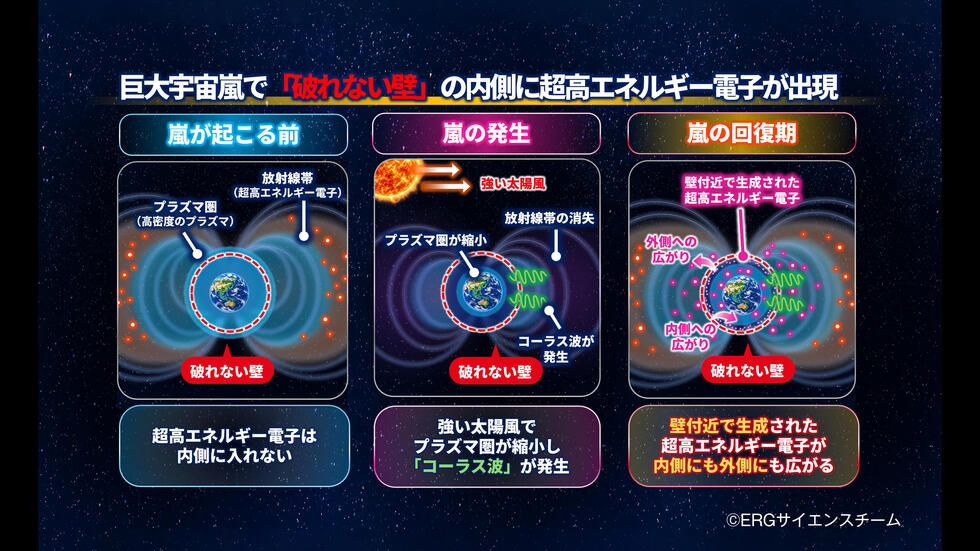
The inner radiation belt (L* < 3) has long been considered an impenetrable barrier to ultra-relativistic electrons. Here we show that this barrier can be breached under extreme space weather conditions. Using continuous near-equatorial observations from the Arase satellite, we show that the May 2024 superstorm rapidly generated multi-MeV electrons deep inside the inner magnetosphere. Phase space density profiles reveal the development of a local maximum at L* ∼ 3, providing evidence that local in situ acceleration established multi-MeV electron source before supplying inward and outward radial diffusion. Simultaneous observations of intense chorus waves under a strongly depleted plasma region, maintained by enhanced convection and a negative ionospheric storm, are consistent with chorus-driven local acceleration. These findings demonstrate that local acceleration can establish a multi-MeV electron source inside the impenetrable barrier under extreme space weather conditions.

