
動的クラスタリングにより、計算資源が限られた環境でのニューラルネットワークを高速化(Optically Addressed Metasurface Enables Programmable Control of Diffraction and Polarization)

2026-10-12 中国科学院長春光学精密機械物理研究所

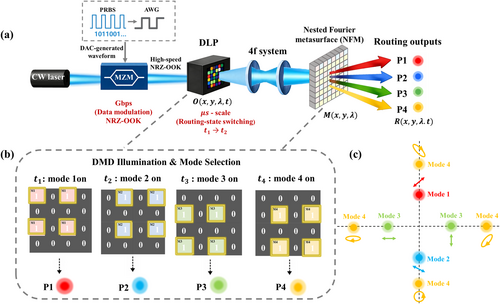
中国科学院(CAS)長春光学精密機械物理研究所(CIOMP)などの研究チームは、投影光によって回折方向と偏光状態を切り替えるメタサーフェスを提案し、数値シミュレーションで性能を評価した。研究成果は学術誌 Nanophotonics に掲載された。提案手法では、ナノ構造をあらかじめ最適化した平面光学素子に、デジタル光処理装置から選択的な光パターンを投影し、複数の光出力経路を切り替える。ナノ構造ごとに電気配線を設けることなく、単一チャネル、2チャネル、4チャネルの光制御を実現する設計が示された。単一チャネル動作では、回折効率約45%、偏光忠実度0.99超を達成した。また、通信速度25Gbpsのリンクシミュレーションでは、検討した通信帯域において誤り率が前方誤り訂正の閾値を下回った。本技術は光通信インターコネクトやプログラマブル光信号処理の小型化に貢献する可能性がある。ただし、現段階は数値実証であり、実機での損失や切替性能、チャネル間干渉の検証が今後の課題である。

<関連情報>

光学的にアドレス指定可能なネスト型フーリエメタサーフェスによるプログラム可能な多次元回折エンジニアリング Programmable Multidimensional Diffraction Engineering via an Optically Addressed Nested Fourier Metasurface

Jing Guo, Qinglei Zhao, Jingrui Yang, Zongyi Liu, Mingdong Zhu, Shuai Liu, Chao Li, Shuxin Wang, Qinglong Hu, Fengwei Guan, Qiang Liu, Qi Song
Nanophotonics First published: 07 October 2026
doi.org/10.1002/nap2.70309Digital Object Identifier (DOI)

ABSTRACT

Details are in the caption following the image
Free-space optical routing and programmable Fourier optical processing are promising for next-generation photonic information systems. Here, we propose an optically addressed nested Fourier metasurface (OA-NFM) platform for dynamically switchable, multidimensional optical routing and diffraction-channel engineering without dense electrical interconnects. By integrating a Fourier-coefficient-based inverse-design method with a nested Fourier metasurface architecture, the proposed platform enables simultaneous control of diffraction channels and polarization states. By spatially multiplexing Fourier-engineered mode regions within nested supercells and activating them through digital light processing (DLP)-based optical addressing, the OA-NFM achieves programmable momentum-space redistribution, sideband clustering, and angular-channel engineering via controllable superlattice diffraction. The local Fourier mode defines the target diffraction response, while the global nested array factor controls the angular distribution of clustered sidebands. Simulations show that individually optimized modes achieve diffraction efficiencies up to 45% with polarization fidelities above 0.99. The OA-NFM achieves diffraction efficiencies up to 37% within the ± 1.1° receiver window, excluding losses from the DMD and projection optics. NRZ-OOK simulations confirm BERs below the hard-decision FEC threshold (10−3) at 25 Gbps across the 1500–1600 nm band. This work demonstrates a promising platform for optical switching, free-space routing, and multidimensional photonic information processing.
Abstract

Deep reinforcement learning (DRL)–based convolutional neural network pruning methods provide an effective framework for automated model compression from both theoretical and practical perspectives. However, existing DRL-based pruning approaches often neglect the functional characteristics and similarities of channels in network state representation. In addition, their action spaces are typically designed to generate layer-wise pruning ratios, which limits their ability to directly identify redundant channels. To address these limitations while enabling efficient deployment and acceleration on general-purpose hardware, we propose Dynamic Clustering for Channel Pruning (DCCP). Specifically, multi-frequency channel response statistics are employed to characterize the network state, thereby providing the agent with essential prior information for refined decision-making. Furthermore, we design a Dynamic Clustering Agent that exploits the representational capacity of hypergraph convolution to integrate complex channel-wise information and model high-order functional similarities among channels. This design enables the agent to effectively identify redundant channels for pruning. The proposed method is evaluated on two remote sensing scene classification datasets, NWPU-RESISC45 and NaSC-TG2. Experimental results on NaSC-TG2 show that DCCP reduces the floating-point operations of ResNet-50 by 68.52%, while achieving acceleration ratios of 1.41 × on a GPU and 1.24 × on a mobile embedded platform, with competitive classification accuracy.
0403電子応用
ad
ad
Follow
ad
タイトルとURLをコピーしました