2026-10-02 パシフィック・ノースウェスト国立研究所(PNNL)
<関連情報>
- https://www.pnnl.gov/publications/ion-ordering-microphase-separation-how-charge-frustration-organizes-ions-surfaces
- https://www.nature.com/articles/s41563-025-02467-5
電荷フラストレーションが表面におけるイオン秩序化とマイクロ相分離を引き起こす仕組み How charge frustration causes ion ordering and microphase separation at surfaces
Mingyi Zhang, Benjamin A. Legg, Benjamin A. Helfrecht, Yuanzhong Zhang, Shuai Tan, Ying Xia, Rae Karell Yodong, Monica Iepure, Venkateshkumar Prabhakaran, Peter J. Pauzauskie, Younjin Min, Christopher J. Mundy & James J. De Yoreo
Nature Materials
Abstract
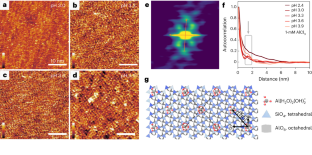
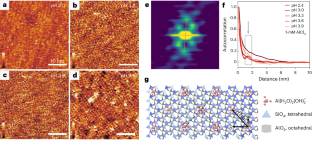
Ion interactions with charged surfaces are fundamental to electrochemical, geochemical and biological systems, yet the impact of charging on interfacial structure and dynamics is poorly understood. Here we investigate the adsorption and precipitation of multivalent ions on mica using molecularly resolved atomic force microscopy. Although divalent ions form continuous hydroxide monolayers in a manner consistent with classical models, trivalent ions adopt complex states associated with strong overcharging, including ordered ion networks, cluster arrays and microphase-separated films not predicted by those models. Monte Carlo simulations show that such states emerge from charge frustration arising when restrictions on repelling charges prevent the minimization of electrostatic forces. Due to their universal nature across cation types, the results provide general principles underlying charge-driven nanostructure formation and insights for using electric fields to direct materials synthesis.