2026-09-30 合肥物質科学研究院(HFIPS)
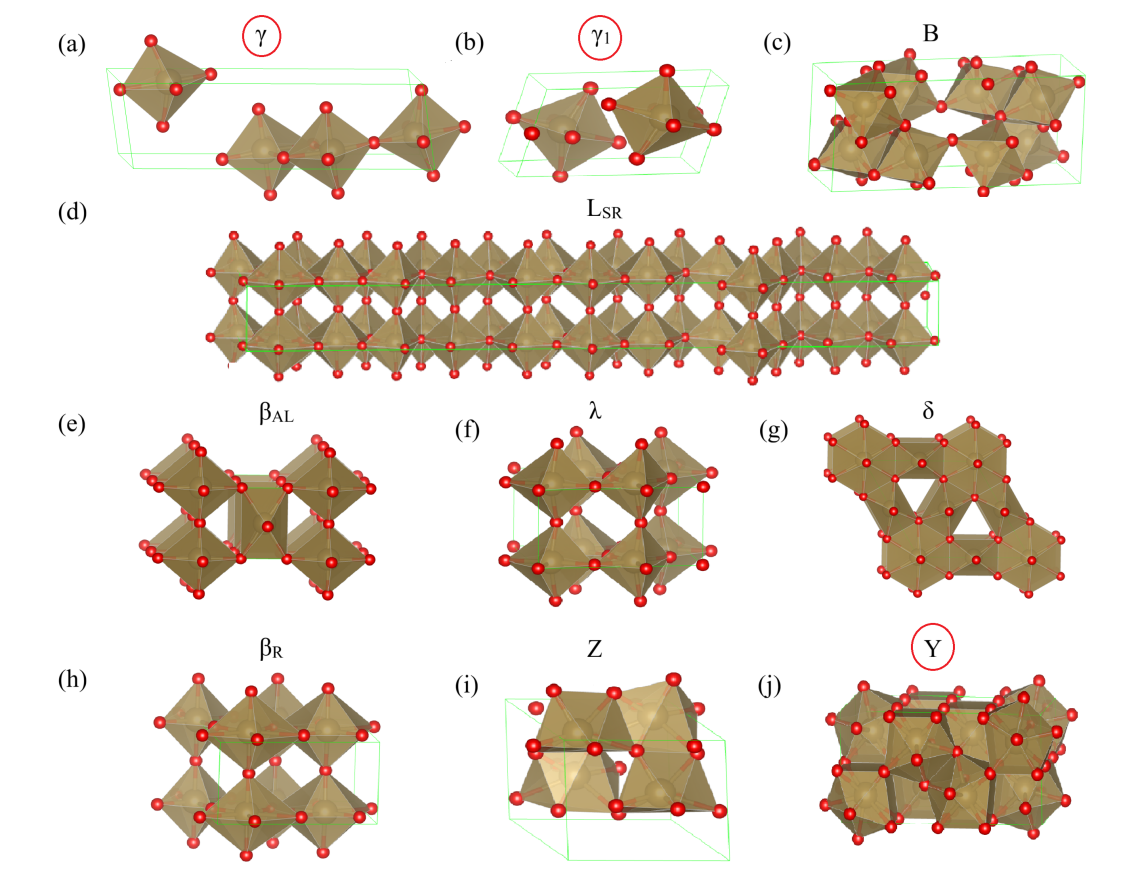
Ten crystal structural models of Ta2O5, among which the γ, γ1 and Y phase are structures predicted by the team. (Image by YANG Yong)
<関連情報>
- https://english.hf.cas.cn/nr/rn/202609/t20260930_1201612.html
- https://journals.aps.org/prb/abstract/10.1103/t42v-kttt
- https://iopscience.iop.org/article/10.1088/1674-1056/ae0925
- https://www.sciencedirect.com/science/article/abs/pii/S0927025623004767
- https://journals.aps.org/prmaterials/abstract/10.1103/PhysRevMaterials.2.034602
第一原理相図Ta2O5 Ab initio phase diagram of Ta2O5
Yan Gong, Huimin Tang, Yong Yang, and Yoshiyuki Kawazoe
Physical Review B Published: 10 July, 2026
DOI: https://doi.org/10.1103/t42v-kttt
Abstract
Tantalum pentoxide (Ta2O5) is a polymorphic wide-band-gap semiconductor with outstanding dielectric properties and widespread use in optical and electronic technologies. Its rich structural diversity, arising from multiple polymorphs accessible under different synthesis conditions, has made Ta2O5 a long-standing subject of interest. However, a unified understanding of the thermodynamic stability and phase transitions of its polymorphs across pressure-temperature (P–T) space has remained elusive. Here, using first-principles calculations, we map the thermodynamic landscape of Ta2O5 and establish a comprehensive P–T phase diagram together with a phase-stability hierarchy. We find that γ-Ta2O5 and B−Ta2O5 dominate the phase diagram over a broad range of P–T conditions: γ−Ta2O5 is stabilized at low pressures, while B−Ta2O5 becomes thermodynamically favored at higher pressures up to ∼60 GPa, beyond which Y-Ta2O5 emerges as the most stable phase. Crucially, the zero-point energy (ZPE), one aspect of nuclear quantum effects (NQEs), plays a significant role in determining relative phase stability, contributing substantially to the Gibbs free energy and altering phase boundaries. A reentrant phase transition between γ- and B−Ta2O5 is predicted near ∼2 GPa, revealing unexpected complexity in the phase behavior of this oxide. More generally, we identify a characteristic temperature (0), at which zero-point and thermal phonon contributions to the free energy become comparable, and show that 0 is approximately one-third of the Debye temperature. This relationship provides a simple, physically transparent criterion for assessing the importance of NQEs in phase stability, with implications extending beyond Ta2O5 to a broad class of complex oxides.
高圧下におけるTa₂O₅の斜方晶相の可能性 Possible orthorhombic phase of Ta2O5 under high pressures
Yan Gong (龚艳), Hui-Min Tang (唐慧敏), Yong Yang (杨勇) and Yoshiyuki Kawazoe
Chinese Physics B Published:2025
DOI:10.1088/1674-1056/ae0925
Abstract
A potential orthorhombic phase of Ta2O5, designated as Y-Ta2O5, is predicted under high-pressure conditions using density functional theory (DFT) combined with structural search algorithms. This phase, containing four formula units per unit cell (Z = 4), exhibits the highest Ta–O coordination numbers reported to date. Y-Ta2O5 is identified as the most energetically stable form of Ta2O5 within the pressure range of approximately 70 GPa to at least 200 GPa. Both standard DFT-GGA and higher-accuracy GW calculations indicate that Y-Ta2O5 is a wide-bandgap semiconductor with a direct bandgap. Furthermore, nuclear quantum effects (NQEs) introduce nontrivial corrections to external pressure at fixed volumes, underscoring their significance in high-pressure phase stability analyses.
1つの組成式単位を持つTa₂O₅の構造的および電子的特性 Structural and electronic properties of Ta2O5 with one formula unit
Yangwu Tong, Huimin Tang, Yong Yang
Computational Materials Science Available online: 11 September 2023
DOI:https://doi.org/10.1016/j.commatsci.2023.112482
Highlights
- A triclinic phase of Ta2O5 whose unit cell contains one formula unit (Z = 1) is identified theoretically at atmospheric pressure.
- The phase is energetically the most stable among the Z = 1 Ta2O5 phases.
- The phase may be taken as the elementary building block of the other more complex phases of Ta2O5.
Abstract
Based on particle swarm optimization (PSO) algorithm and density functional theory (DFT) calculations, we identify a stable triclinic crystal structure of Ta2O5 (named as γ1-Ta2O5) at atmospheric pressure whose unit cell contains one formula unit (Z = 1). Comparison with the Z = 1 Ta2O5 structures from the Materials Project [APL Mater. 1, 011,002 (2013)] reveals that γ1-Ta2O5 is energetically the most stable among the Z = 1 Ta2O5 phases, and is the second most stable among all the Ta2O5 phases. Characterization of γ1-Ta2O5 is carried out by analyzing the X-ray powder diffraction patterns, the elastic, vibrational, thermal and electronic properties. The electronic structures of γ1-Ta2O5 are calculated using standard DFT as well as many-body perturbation theory within the GW approximation. The results indicate that γ1-Ta2O5 is a wide band gap semiconductor with an indirect gap of ∼ 3.361 eV.
新しい基底状態結晶構造の予測T12O5 Prediction of new ground-state crystal structure of Ta2O5
Yong Yang and Yoshiyuki Kawazoe
Physical Review Materials Published: 13 March, 2018
DOI: https://doi.org/10.1103/PhysRevMaterials.2.034602
Abstract
Tantalum pentoxide (Ta2O5) is a wide-gap semiconductor which has important technological applications. Despite the enormous efforts from both experimental and theoretical studies, the ground-state crystal structure of Ta2O5 is not yet uniquely determined. Based on first-principles calculations in combination with evolutionary algorithm, we identify a triclinic phase of Ta2O5, which is energetically much more stable than any phases or structural models reported previously. Characterization of the static and dynamical properties of the phase reveals the common features shared with previous metastable phases of Ta2O5. In particular, we show that the spacing of ∼3.8Å found in the x-ray diffraction patterns of many previous experimental works is actually the radius of the second Ta-Ta coordination shell as defined by radial distribution functions.