2026-09-30 中国科学院(CAS)
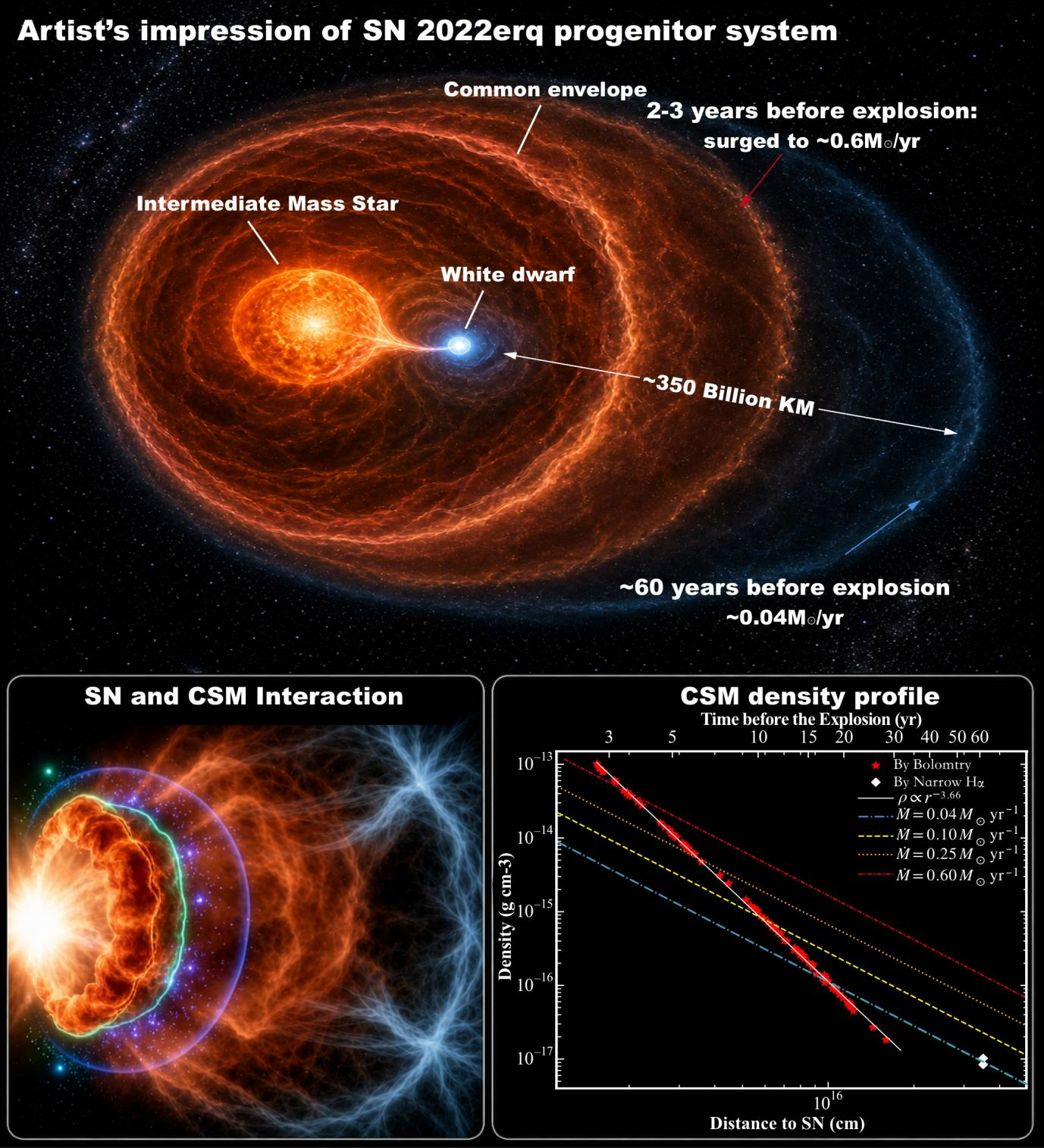
Schematic illustration of the progenitor system, circumstellar environment, and post-explosion interaction of SN 2022erq. The top panel shows an artist’s impression of the progenitor system; the lower-left panel illustrates the SN-CSM interaction; and the lower-right panel presents the measured CSM density profile. (Image by ZHAI Qian)
<関連情報>
- https://english.cas.cn/newsroom/research-news/202609/t20260930_1201607.shtml
- https://iopscience.iop.org/article/10.3847/1538-4357/ae8a46
SN 2022erq:爆発前の質量損失が増大する超高輝度熱核超新星 SN 2022erq: A Superluminous Thermonuclear Supernova with Escalating Preexplosion Mass Loss
Qian Zhai, Jujia Zhang, Xiaofeng Wang, A. Pastorello, Alexei V. Filippenko, József Vinkó, Thomas G. Brink, Yunkun Han, G. Valerin, N. Elias Rosa,…
The Astrophysical Journal Published: 2026 August 18
DOI:10.3847/1538-4357/ae8a46
Abstract
We present a photometric and spectroscopic study of the superluminous Type Ia supernova SN 2022erq. Its early spectra, dominated by iron-group elements with weak intermediate-mass features, might indicate highly efficient nuclear burning, broadly similar to that inferred for some overluminous Type Ia supernovae. The rapid emergence and persistence of narrow Balmer emission lines superposed on this iron-rich spectrum provide clear evidence of long-lived interaction with a hydrogen-rich circumstellar medium (CSM), establishing SN 2022erq as a member of the rare Ia–CSM class. SN 2022erq reached a peak bolometric luminosity of ∼8 × 1043 erg s−1 and exhibited an exceptionally slow postpeak decline, indicating that its light curve is dominated by long duration ejecta–CSM interaction. By combining Hα diagnostics with bolometric light-curve modeling, we reconstruct the preexplosion mass-loss history of the progenitor. The mass-loss rate escalated by 1 order of magnitude over the final decades, rising from ∼0.04 to ∼0.6 M⊙ yr−1. This surge produced a massive, extended CSM shell of ∼3 M⊙ out to ∼3.5 × 1016 cm. The young stellar environment (∼100 Myr) together with this substantial, extensive CSM points to a progenitor system consisting of a white dwarf and an intermediate-mass companion that underwent increasing mass loss prior to explosion.