2026-06-08 アメリカ合衆国・メリーランド大学(UMD)
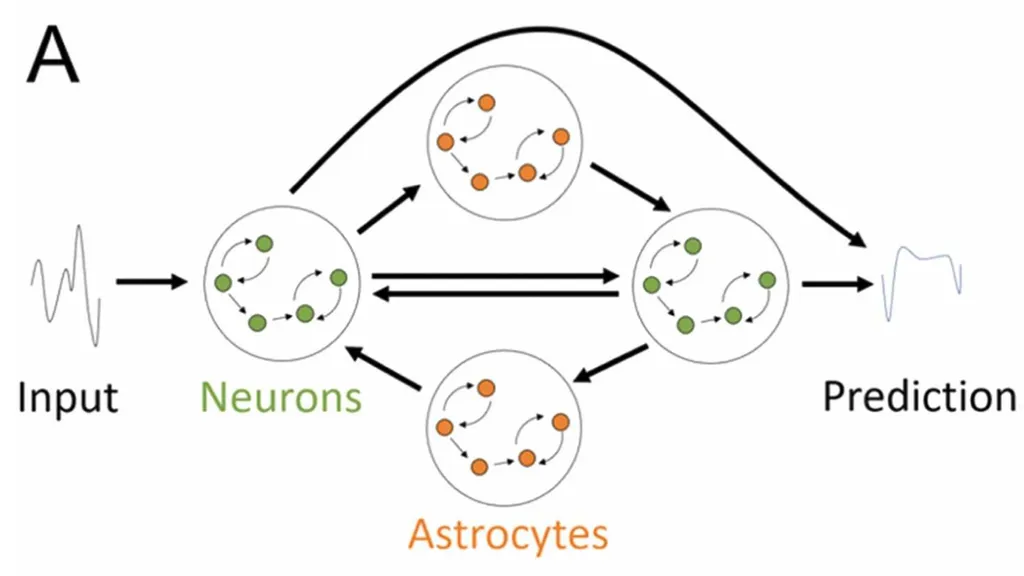
In the team’s AI network, artificial neurons (green) and astrocytes (orange) are wired together to replicate the way the two cell types communicate in the human brain. (Image courtesy of Yang et al., Neurocomputing)
<関連情報>
- https://today.umd.edu/inspired-by-brains-hidden-half-umd-led-project-aims-for-smarter-ai
- https://www.nature.com/articles/s44335-026-00067-3
- https://journals.aps.org/prresearch/abstract/10.1103/fdc2-ljj6
- https://www.sciencedirect.com/science/article/pii/S092523122600202X?via%3Dihub
グリア細胞に着想を得た「リズミカルな共有」アルゴリズムにおける概念ドリフトの創発的検出 Emergent detection of concept drift within the glia-inspired ‘rhythmic sharing’ algorithm
Ian Whitehouse, Hoony Kang & Wolfgang Losert
npj Unconventional Computing Published:03 June 2026
DOI:https://doi.org/10.1038/s44335-026-00067-3
Abstract
Biological rhythms coordinate adaptive sensing and computation, spontaneously demonstrating concept drift detection abilities. We demonstrate that our oscillatory learning scheme, called rhythmic sharing, can autonomously detect concept drift. Inspired by astrocytic oscillations, the algorithm has recurrent links that vary sinusoidally, producing emergent sensitivity to distributional drift. We introduce a new measure, called per-input synchrony, which harnesses this sensitivity to enable early and precise detection of hidden or complex drifts. Across three datasets, NASA C-MAPSS, SWaT, and WADI, the output of our per-input synchrony features improves detector performance, culminating in new state-of-the-art F1-scores on the complex SWaT and WADI datasets. These industrial datasets highlight the ability of our model to detect drift in highly-complex, real-world systems. Additionally, these results suggest that oscillatory link dynamics may serve as a general computational principle for adaptive sensing, with implications for neuromorphic hardware and astrocytic network biology.
リズミカルな共有:ニューラルネットワークにおけるゼロショット適応学習のための生物着想型パラダイム Rhythmic sharing: A bioinspired paradigm for zero-shot adaptive learning in neural networks
Hoony Kang and Wolfgang Losert
Physical Review Research Published: 10 March, 2026
DOI: https://doi.org/10.1103/fdc2-ljj6
Abstract
The brain rapidly adapts to new contexts and learns from limited data, a coveted characteristic that artificial intelligence (AI) algorithms struggle to mimic. Inspired by the mechanical oscillatory rhythms of neural cells, we developed a learning paradigm utilizing link strength oscillations, where learning is associated with the coordination of these oscillations. Link oscillations can rapidly change coordination, allowing the network to sense and adapt to subtle contextual changes without supervision. The network becomes a generalist AI architecture, capable of predicting dynamics of multiple contexts, including unseen ones. These results make our paradigm a powerful starting point for models of cognition. Because our paradigm is agnostic to specifics of the neural network, our study opens doors for introducing rapid adaptive learning into leading AI models.
人工アストロサイトを用いたスパイクニューラルネットワークにおける学習特性の解明 Characterizing learning in spiking neural networks with artificial astrocytes
Christopher S. Yang, Sylvester J. Gates III, Dulara De Zoysa, Jaehoon Choe, Wolfgang Losert, Corey B. Hart
Neurocomputing Available online: 21 January 2026
DOI:https://doi.org/10.1016/j.neucom.2026.132805
Abstract
Traditional artificial neural networks take inspiration from biological networks, using layers of neuron-like nodes to pass information for processing. More realistic models include spiking in the neural network, capturing the electrical characteristics more closely. However, a large proportion of brain cells are of the glial cell type, in particular astrocytes which have been suggested to play a role in performing computations. Here, we introduce a modified spiking neural network model incorporating artificial astrocytes and assess their impact on learning. We implement the network as a liquid state machine and task the network with performing a chaotic time-series prediction task. We varied the number and ratio of artificial neurons and astrocytes in the network to examine the latter units’ effect on learning. We show that networks combining both neurons and astrocytes together, as opposed to neural- and astrocyte-only networks, are critical for driving learning. Interestingly, we found that the highest learning rate was achieved when the ratio between artificial astrocytes and neurons was roughly 2:1, mirroring some estimates of the ratio of biological astrocytes to neurons. Our results demonstrate that incorporating artificial astrocytes which represent information across longer timescales can alter the learning rates of neural networks, and the proportion of astrocytes to neurons should be tuned appropriately to a given task.