2026-09-24 東北大学
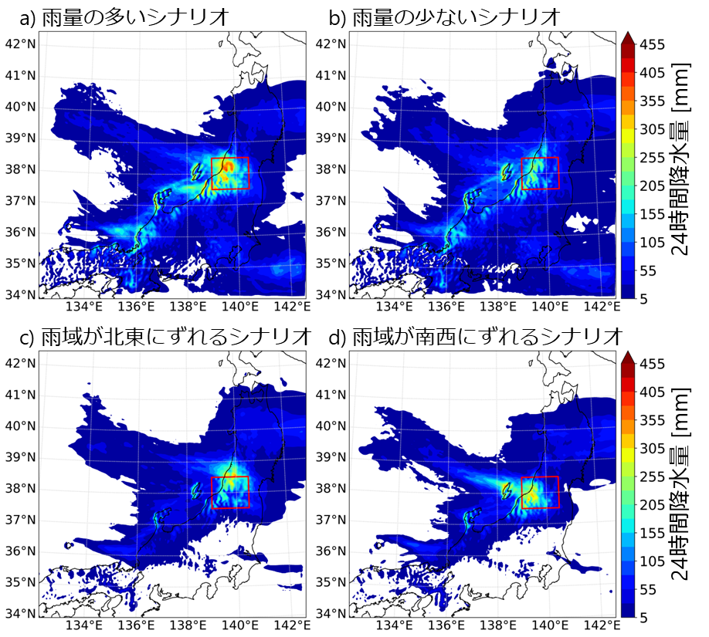
図1. 2022年8月に山形県・新潟県において発生した線状降水帯事例について、アンサンブル計算から得られる雨量の多い・少ないシナリオと、雨域が北東・南西にずれるシナリオの24時間雨量。
<関連情報>
- https://www.tohoku.ac.jp/japanese/2026/09/press20260924-02-rainband.html
- https://agupubs.onlinelibrary.wiley.com/doi/10.1029/2026JD047391
北日本における線状メソスケール対流系に伴う極端な降雨強度と位置を制御する要因とは?アンサンブルに基づくアプローチ What Controls Extreme Rainfall Intensity and Location Associated With Line-Shaped MCSs Over Northern Japan? An Ensemble-Based Approach
Ryotaro Tahara, Yusuke Hiraga
Journal of Geophysical Research: Atmospheres Published: 18 September 2026
DOI:https://doi.org/10.1029/2026JD047391
Abstract
Line-shaped mesoscale convective systems (MCSs) frequently produce extreme rainfall and severe hydrological disasters in Japan. This study investigates the environmental controls on both rainfall intensity and spatial displacement associated with two line-shaped MCS events over northern Japan using convection-permitting ensemble simulations. Ensemble members were classified according to precipitation magnitude and location, comparing corresponding thermodynamic and dynamical environmental fields. The results show that rainfall intensity is primarily controlled by the amount of moisture transport and the strength of moisture flux convergence near the precipitation area. In contrast, rainfall location is governed by the pathway of moisture transport and the position at which moisture convergence forms. These differences are linked to variations in pressure-field configurations, especially the evolution and positioning of mesoscale low-pressure systems that stagnate near the upstream side of the precipitation region. Low-pressure systems located closer to the precipitation region enhance low-level winds, moisture convergence, and upward motion, thereby favoring more intense rainfall. The relative position of low-pressure systems also determines the pathway of moisture transport and the location of moisture convergence, determining where precipitation develops. These results suggest that accurate representation of both the intensity and positioning of mesoscale pressure systems is critical for improving forecast skill. In addition to identifying the factors controlling precipitation intensity, analyzing the factors controlling precipitation displacement is essential for basin-scale hydrological risk assessment, because even modest location errors can substantially alter accumulated rainfall over river basins.