2026-09-17 ノースウェスタン大学
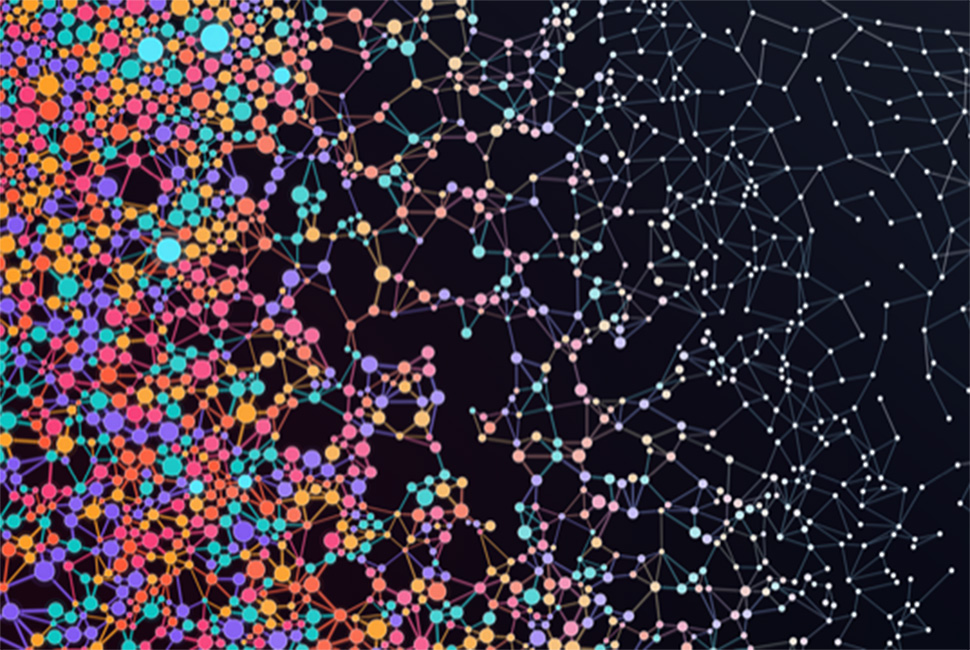
Scientists developed a mathematical framework to identify when disorder can actually make a system more stable. The research suggests scientists and engineers could harness deliberately designed differences to build more robust power grids, architected materials and other interconnected systems. Image by Camila Felix
<関連情報>
- https://news.northwestern.edu/stories/2026/09/networks-could-benefit-from-more-disorder
- https://www.science.org/doi/10.1126/science.aeg3946
- https://www.nature.com/articles/s41567-019-0742-y
無秩序によって促進される安定性 Disorder-promoted stability
Arthur N. Montanari, Pietro Zanin, and Adilson E. Motter
Science Published:17 Sep 2026
DOI:https://doi.org/10.1126/science.aeg3946
Abstract
Previous studies of network dynamics have suggested that heterogeneity among nodes inhibits stability, which is at odds with the ubiquity of inherently heterogeneous natural and engineered systems. Here, we show that this conclusion arises from model reductions introduced for mathematical tractability and breaks down when nodal dynamics are higher-dimensional, yielding non-Hermitian Jacobians. In such systems, including neural, power-grid, and material networks, nodal heterogeneity can instead enhance stability, even when parameters are randomly disordered. Non-Hermiticity also underlies the stabilizing effects of network heterogeneity, which can arise even in one-dimensional nodal dynamics through nonreciprocal interactions, as shown for ecological networks. Our framework reveals disorder not as a liability but as a general resource for stabilizing complex systems.
ネットワーク実験により、逆対称性の破れが実証される Network experiment demonstrates converse symmetry breaking
Ferenc Molnar, Takashi Nishikawa & Adilson E. Motter
Nature Physics Published:20 January 2020
DOI:https://doi.org/10.1038/s41567-019-0742-y
Abstract
Symmetry breaking—the phenomenon in which the symmetry of a system is not inherited by its stable states—underlies pattern formation, superconductivity and numerous other effects. Recent theoretical work has established the possibility of converse symmetry breaking, a phenomenon in which the stable states are symmetric only when the system itself is not. This includes scenarios in which interacting entities are required to be non-identical in order to exhibit identical behaviour, such as in reaching consensus. Here we present an experimental demonstration of this phenomenon. Using a network of alternating-current electromechanical oscillators, we show that their ability to achieve identical frequency synchronization is enhanced when the oscillators are tuned to be suitably non-identical and that converse symmetry breaking persists for a range of noise levels. These results have implications for the optimization and control of network dynamics in a broad class of systems whose function benefits from harnessing uniform behaviour.