2026-09-17 合肥物質科学研究院(HFIPS)
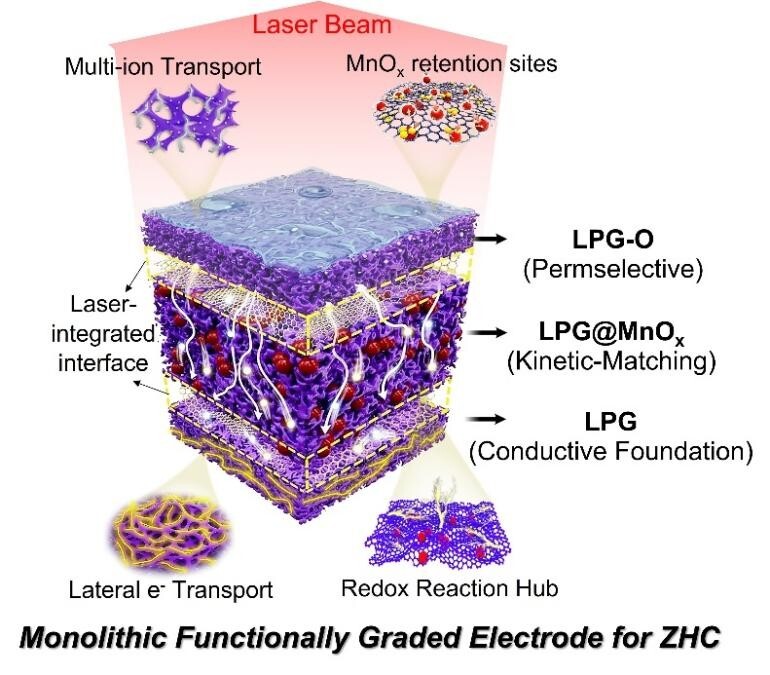
Figure 1. Schematic illustration of the step-wise functionally graded LPG/LPG@MnOx/LPG-O thick electrode. (Image by LI Nian)
<関連情報>
- https://english.hf.cas.cn/nr/bth/202609/t20260917_1200783.html
- https://www.sciencedirect.com/science/article/abs/pii/S1359836826007924
レーザー加工による高レート亜鉛イオンハイブリッドキャパシタ用一体型厚膜機能勾配カソード Laser-engineered monolithic thick functionally graded cathodes for high-rate zinc-ion hybrid capacitors
Jun Kang, Zheng Xu, Yudong Wang, Wenjie Shao, Zhuang Miao, Nian Li , Yanping Song, Shuai Han, Kaixiang Ren, Li Zhong, Zhao Li, Zhiyuan Yang, Na Hong, Shudong Zhang, Zhenyang Wang
Composites Part B: Engineering Available online: 29 August 2026
DOI:https://doi.org/10.1016/j.compositesb.2026.114171
Highlights
- All-laser engineering enables a binder-free monolithic graded thick cathode.
- Laser-integrated continuity replaces vulnerable physical interlayer contacts.
- Top LPG-O regulator facilitates hydrated Zn2+ flux and reduces active-material loss.
- At 13.47 mg cm−2, the thick cathode delivers 7.89 F cm−2 with 93.6% retention.
- Full ZHC delivers 81.95 Wh kg−1 based on total electrode mass and 90.2% retention.
Abstract
Developing thick electrodes for zinc-ion hybrid capacitors (ZHCs) is impeded by sluggish ion-transport kinetics and electrochemically induced contact degradation associated with divalent Zn2+ cycling. To address these limitations, a monolithically integrated, step-wise functionally graded architecture (LPG/LPG@MnOx/LPG-O) is designed via a sequential laser-engineering strategy. In this architecture, the MnOx-embedded laser-induced porous graphene (LPG) interlayer (LPG@MnOx) features interconnected porous channels to facilitate electrolyte accessibility and liquid-phase transport of solvated Zn2+. The top oxygen-enriched layer (LPG-O) functions as a kinetic regulation layer that improves initial electrolyte infiltration and liquid-phase accessibility. Electrochemical kinetic analysis indicates that its contribution is primarily associated with reduced interface-related polarization. Its hydrophilic porous structure promotes electrolyte access, while post-cycling analyses support reduced irreversible Mn loss and partial redistribution/retention of Mn-related species within the upper region. Unlike physically stacked structures, the laser-integrated architecture provides reduced through-thickness resistance and preserves the principal integrated morphology during prolonged high-rate cycling. Consequently, the resulting thick electrode delivers a high areal capacitance of 7.89 F cm−2 and retains 93.6% of its capacitance after 12,000 cycles. When assembled into a ZHC device, it achieves an energy density of 81.95 Wh kg−1 based on the total mass of both positive and negative electrodes, together with high-power durability, retaining 90.2% after 15,000 cycles at 5.0 A g−1. This study demonstrates that moving beyond simple physical stacking to implement a laser-integrated, step-wise functionally graded architecture improves electronic continuity and electrolyte accessibility, reduces irreversible Mn loss, and enhances cycling durability in thick electrodes.