

2026-09-15 京都大学
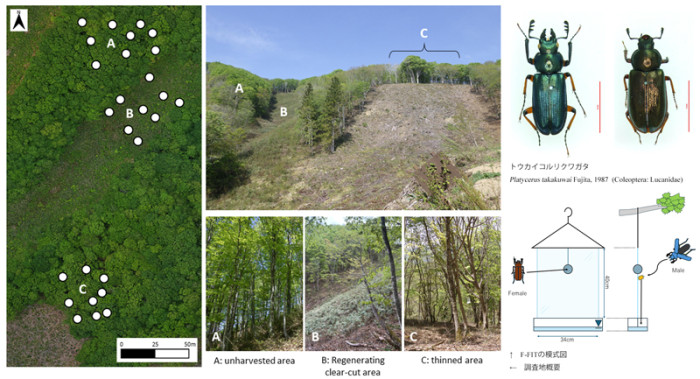
撮影・作図:時任美乃理、淺野悟史
<関連情報>
- https://www.kyoto-u.ac.jp/ja/research-news/2026-09-15-0
- https://www.sciencedirect.com/science/article/pii/S0378112726007231
クワガタムシ科(鞘翅目:クワガタムシ科)のハニートラップ:地理参照された捕獲データは、広葉樹林業における森林生息地のパターンを示している A honey trap for Platycerus (Coleoptera: Lucanidae): Georeferenced captures indicate forest-habitat patterns in operational broadleaf forestry
Minori Tokito, Satoshi Asano, Osuke Maenaga, Izuru Saizen, Naoko Tokuchi
Forest Ecology and Management Available online: 6 September 2026
DOI:https://doi.org/10.1016/j.foreco.2026.124225
Highlights
- F-FIT quantified spatial variation in male P. takakuwai captures.
- Captures increased toward forest interiors and declined toward openings.
- Stand-density associations varied spatially, with uncertain local effects.
- Georeferenced F-FIT data complemented stand- or plot-level assessments.
- Results inform retention, opening size, and operational-element discussions.
Abstract
Biodiversity-oriented broadleaf forestry needs practical indicators that translate local forest-habitat conditions into information useful for silvicultural and operational decisions. Here, we used the Female-attracted Flight Interception Trap (F-FIT) to quantify spatial variation in male captures of Platycerus takakuwai Fujita, 1987 (Coleoptera: Lucanidae) as a local habitat indicator in a broadleaf forestry landscape in Hida, Japan. We sampled 27 trap locations spanning unharvested forest, a regenerating clear-cut opening, and an area thinned for temporary cable-yarding tower installation. Each location was sampled in the morning and afternoon, yielding 54 1-h F-FIT deployments. Capture counts were analyzed using negative-binomial spatial models. After evaluating contextual variables, including air temperature, wind speed, elevation, and potential solar radiation, the main model examined whether the association between stand density and captures varied spatially while accounting for edge distance, sampling period, spatial structure, and repeated sampling. A complementary edge-focused model summarized the overall association between forest edge position and captures. The association between stand density and captures was better represented as spatially varying than by a single coefficient shared across the study area, although local coefficients remained uncertain. The most negative point estimates occurred in the thinned area. The edge-focused model indicated that expected capture rates increased toward forest interior positions and decreased toward open areas. F-FIT capture data can, therefore, translate point-level Platycerus responses into spatially explicit information on broad edge-related gradients and locally varying stand-structural associations. This approach can complement stand- or plot-level assessments by informing discussions of retention placement, opening size, and operational elements.
