2026-09-14 中国科学院(CAS)
<関連情報>
- https://english.cas.cn/newsroom/research-news/202609/t20260914_1200391.shtml
- https://link.springer.com/article/10.1007/s10457-026-01634-0
カルスト地帯の農林業システムにおける多元素化学量論的調節と栄養素の結合:持続可能な土地管理への示唆 Multi-element stoichiometric regulation and nutrient coupling in karst agroforestry systems: implications for sustainable land management
Shujie Chen,Yuanyang Chen,Xiaoling Zeng,Chuan Jiang,Xiuhao Yang,Wanglan Tao,Manlian Wang,Jun Ren,Fuzhao Huang & Chenggang Liu
Agroforestry Systems Published:22 August 2026
DOI:https://doi.org/10.1007/s10457-026-01634-0
Abstract
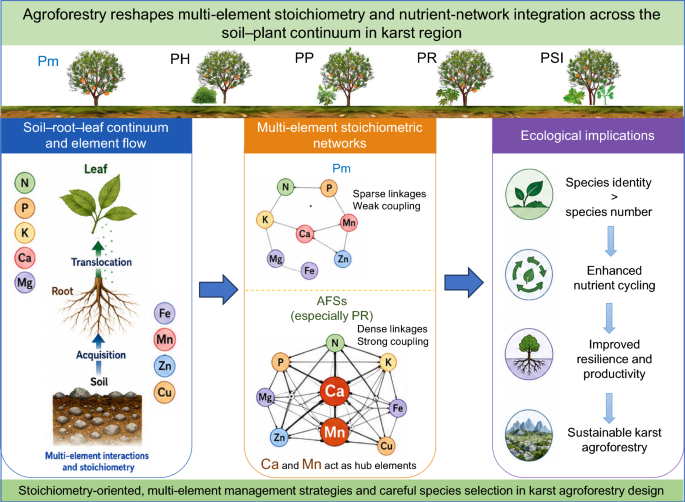
Karst regions of southwestern China are characterized by severe soil nutrient limitations, posing major challenges to agricultural sustainability and ecosystem functioning. Agroforestry systems (AFSs) have been widely promoted to improve soil fertility and ecosystem stability in these fragile environments, yet their effects on multi-element stoichiometric organization across the soil–plant continuum remain poorly understood. Here, we compared a Prunus salicina monoculture (Pm, control) with four P. salicina-based AFSs incorporating medicinal understory species (Hypericum monogynum, Polygala fallax, Rubus suavissimus, and Semiliquidambar cathayensis + Illicium difengpi) in the karst region of the Lijiang River Basin. Concentrations of macro- and metallic elements and their stoichiometric relationships were quantified in soils, roots, and leaves to evaluate nutrient acquisition, translocation, and elemental coordination. Relative to Pm, AFSs substantially restructured elemental composition and multi-element stoichiometry across the soil–plant continuum, with the P. salicina–Rubus suavissimus system showing the greatest increases in nutrient bioaccumulation and elemental-network connectivity. Plant nutrient acquisition was more strongly associated with stoichiometric coupling than with absolute soil elemental concentrations, indicating that nutrient regulation was governed primarily by multi-element balance. Variance partitioning analysis revealed that species identity, rather than the number of intercropped species, was the dominant driver of variation in elemental composition and stoichiometric characteristics. Network analysis further identified Ca and Mn as key integrators linking nutrient dynamics across soil, root, and leaf compartments. These findings demonstrate that multifunctional AFSs enhance nutrient coordination through the reorganization of multi-element stoichiometric relationships and provide a mechanistic basis for species selection and stoichiometry-oriented nutrient management in karst agroforestry.